


As a child, you lived in an enchanted world. You were sure that superheroes were real. Maybe you waited for your letter from Hogwarts long after it was due. Or you wondered when you might wake up one day where you really belong, in a hobbit hole in the Shire — somewhere that inexplicably felt more real than your world.
Then, gradually, education and ordinary experience weakened our senses of the miraculous, the mysterious, and the enchanted. Mechanism and probability give us a tidier but somehow diminished picture of reality. The world became ordinary, and everything suddenly has a reductive explanation.
C.S. Lewis noticed something about that loss in his work The Discarded Image, his study of the medieval mind. When the modern person looks at the night sky, Lewis observed, he feels he is looking out into a void that has no interest in him.
The medieval person, in contrast, felt he was looking in, toward something ordered and inhabited. The medieval man believed himself inside an ordered cosmos, whereas the modern man sees himself adrift in a random universe.
Max Weber identified this change in 1917, in a lecture that has haunted Western thought since. He called it Entzauberung — disenchantment. He wrote “There are no mysterious incalculable forces that come into play, but rather one can, in principle, master all things by calculation. This means that the world is disenchanted.” He was wrong, but the counter-enchantment would arise from unlikely places…
Reminder: You can support us in forming minds and rebuilding the West by unlocking our members-only content:
✔️ Full premium articles every Tuesday
✔️ The entire archive: Western history, literature, and culture
✔️ The Great Books lists (Hundreds of titles that influenced Western thought)
Join to start reading and support the mission today 👇
What “Enchanted” Actually Meant
Chesterton captured the enchanted worldview better than anyone else in his book Orthodoxy, where he wrote “The only words that ever satisfied me as describing Nature, are the terms used in the fairy books — ‘charm,’ ‘spell,’ ‘enchantment.’ They express the arbitrariness of the fact and its mystery. A tree grows fruit because it is a magic tree. Water runs downhill because it is bewitched. The sun shines because it is bewitched.”
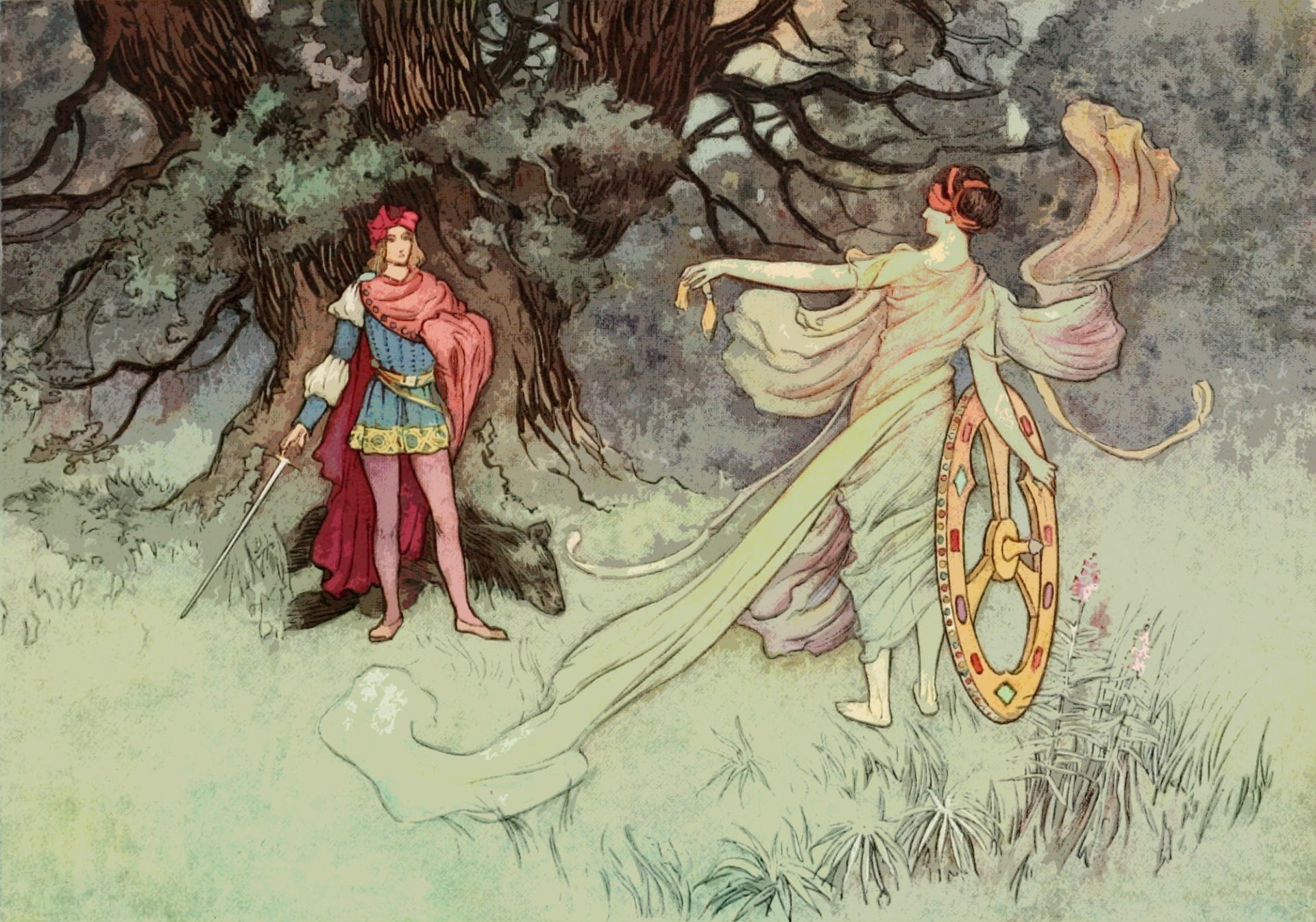
This sounds like typical whimsical Chesterton — and it is, but behind his wit, Chesterton always had a real metaphysical point. The fact that water runs downhill is not self-explanatory. Yes, we have gravity, but the forces of nature at the formation of the universe may well have made gravity a repulsive instead of attractive force. The fact that the sun rises is not inevitable if Earth were to adopt the rotation and orbit of some other far-off planets we’ve since discovered.
These things happen because the idea of causality first exists at all — the hand of God — keeping them in motion through the continuation of existence itself. The enchanted mind might understand probability, but doesn’t see it as the only ruling decision-maker in the universe. It leaves room for a story, a Creator, or at least an acknowledgement that there is still a great deal of mystery in the world, and these all allow the enchanted mind to maintain a sense of wonder and curiosity. A world experienced as intentional and storied generates the question why in a way a purely mechanical world eventually must ignore. If everything reduces to a blind process, the question “why” never really gets answered.
In the medieval world, belief in an enchanted world manifested in many ways: in a sure understanding of humanity’s place in the universe, in the Church’s teaching on spiritual truths, in fables, legends, and folklore, but also in less edifying forms as in village healers, snake-oil salesmen, and those believed to really be meddling in dark arts. The Church was not the source of all enchantment in medieval life, but it was the institution that discerned between what was holy, what was harmless superstition, and what was genuinely dangerous. But what really begins to poke holes in our modern disenchantment is the idea of miracles.
Discerning Miracles
Despite common accusations, the Church has always been its most rigorous skeptic when it comes to the miraculous.
The medieval Catholic Church built an entire apparatus — canonical investigations, medical examination boards, waiting periods measured in decades or longer — specifically to separate genuine miracles from wishful thinking, psychological episodes, mere coincidence, and fraud. The tradition of discernment of spirits, codified in the Rituale Romanum and refined across centuries of theological debate, was designed to distinguish authentic supernatural events from natural ones and, when necessary, from demonic counterfeits. Sacramentals like holy water, blessed medals, and relics gave ordinary Catholics a regular reminder of the ordinary infused with the extraordinary — that the world is more than mere matter. The proper Catholic sense of enchantment was disciplined, not a free-for-all of overactive imaginations.
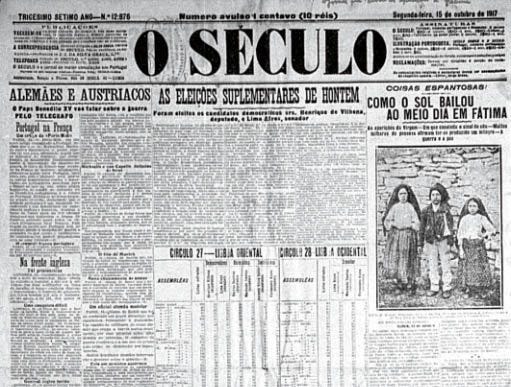
The evidence it produced deserves at least a brief look — even for the nonreligious — to appreciate that miracles are not simply believed without evidence. The public miracle at Fátima, Portugal in October 1917 operated on a scale difficult to explain naturally. Three peasant children had predicted, months in advance, that a public miracle would occur on a specific date at a specific location. Approximately 70,000 people gathered in heavy rain — among them Avelino de Almeida, a senior correspondent for Portugal’s largest secular newspaper, who had mocked the predictions in print beforehand. He filed an eyewitness account describing the sun spinning, changing color, and plunging toward the earth. The article ran on the front page. The editorial staff of an actively anti-clerical publication had no interest in confirming a Catholic miracle. They simply reported what their correspondent saw.
There are many more such miraculous cases we could look at — the strange life of Padre Pio, the hundreds of thousands of miraculous healings associated with holy sites and Marian apparitions, or the many Eucharistic miracles like that of Lanciano. The point isn’t an apologetic one, though that’s certainly something to think about. These are things that happened, were reviewed by professionals, and found wanting for ordinary explanations. There still is a sense of an enchanted world in light of these. Maybe you could chalk it up to our still defective understanding of how the universe works — but that will always be the case. We’ll never understand everything.
The world keeps behaving as though it were enchanted, and so maybe there really is still a story to humanity that we shouldn’t have cast aside in the Enlightenment. But how did we go from an entire society believing that enchantment lay behind every corner to a society where that view is mocked and scoffed at?
Breaking Enchantment
Disenchantment didn’t arrive overnight. Our sense of enchantment was deconstructed piece by piece over several centuries.
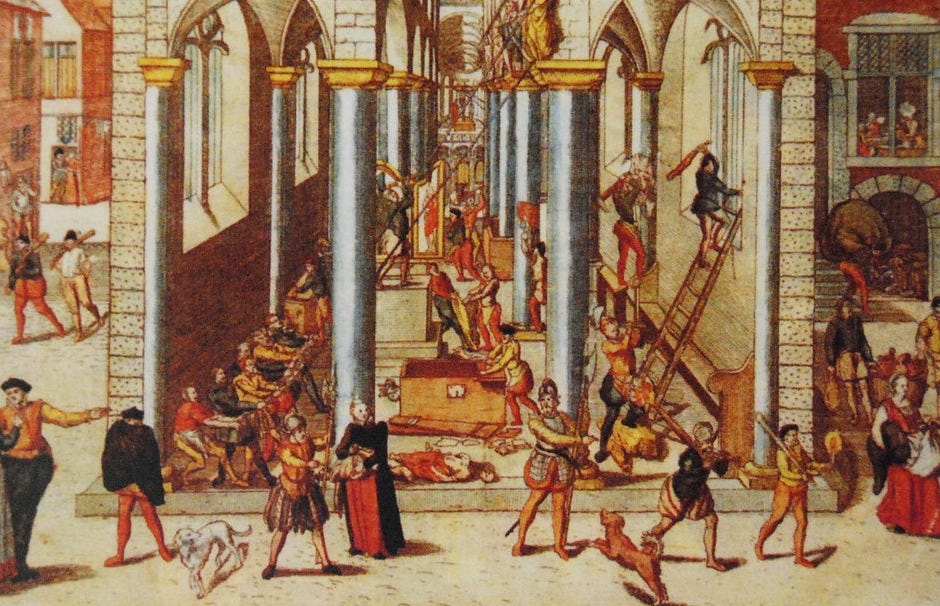
The Reformation’s iconoclasm was perhaps the most visible starting point for the disenchantment of the West. The revolutionary spirit of the Reformers removed statues, relics, and much of Catholicism’s physical mementos from churches, schools, and common places. This wasn’t just the natural result of any religious revolution, however. The Reformers operated on a theological stance that matter carries no sacredness and that images risk idol worship. Whether you agree or disagree with the Reformation’s intent, the practical effect was to strip the physical world of spiritual weight. It began a process of de-spiritualizing the physical signs of Christianity — and this was the first major step in disenchanting the medieval world.
Once the physical marks were removed of their spiritual significance, the philosophers and scientists entered the picture to further drive a wedge between mechanistic and spiritual views of the world.
Descartes proposed a methodical approach to doubt and knowing, by essentially throwing away sure knowledge of anything that he couldn’t reduce to indisputable fact. This left him with just one thing: Cogito, ergo sum — I think therefore I am. The problem lies in the fact that Descartes assumes the only way to knowledge is by deduction — if it is not grounded logically, it cannot be known. But this entirely casts aside the reality of perception as a way of knowing. While Descartes rightly believed perception can be unreliable, we all know there are some things we know to be true because we perceive them first. Virtually all the forces of nature were understood by perception before we understood them by deducing physical principles. Gravity was felt long before Newton could describe its effects on objects.
The doubt of Descartes about perception threw into question all things related to an enchanted world; if it could not be deduced on logical grounds, we have reason for disbelief in even what we perceive directly. This was a huge blow to the common understanding of life and the world as fundamentally charged with mystery and miracles.
As the Enlightenment unfolded, advances in mathematics and formalized logic furthered the view of a mechanistic world — the planetary motions were accurately predicted by this point, chemistry was slowly emerging out of alchemy, Newton could describe gravity’s mysterious pull, and the mathematics of calculus was transforming our ability to capture nature on paper. All this pointed toward a universe guided by mathematics, leaving little room for explanations that defy descriptions by formula.
Weber watched the process reach its conclusion at the turn of the twentieth century and wasn’t pleased about it. His “iron cage” was indeed a trap — the condition of people who had rationalized every source of meaning out of existence and were left a cold, inert world.
And yet at the point where rationalism’s conclusions had been fully drawn out early in the century — giving voice to Nietzsche and foundation to Communism — the enchanted world mounted a comeback…
