

The Church may be in crisis. Without diving into all the political forces at play, Christianity has undoubtedly experienced a sharp decline in participation over the last 60 years — but maybe this challenging era of Christianity at hand is part of something bigger. Just as there are political and social cycles of highs and lows, so too are there rhythms in the life of Christianity.
The Greeks, like Polybius and Plato, recognized patterns of evolution between the many forms of government in what they called the kyklos. Later thinkers would apply the same concepts of a “cycle” to other aspects of historical development, too. Sir John Glubb believes empires to exhibit a six-stage lifecycle lasting approximately 250 years. Authors Howe and Strauss applied this cyclical thinking to social history, noting the rise and inevitable crisis experienced by American society every 85 years in four stages: a High, an Awakening, an Unraveling, and a Crisis.
In a similar vein of thought, we can think of the life of the Church as a progression of highs and lows across its history. The Church has, as perhaps all complex institutions have, a lifecycle, too. Historian Christopher Dawson proposed six ages in the life of the Catholic Church, each lasting between 250 and 500 years long and marked by a period of ascendancy and ending with a major crisis.
Dawson’s ages of the Church are a break with typical historical organization of Church history into ancient, medieval, and modern eras, and he explains why thinking of Church history in these six stages is more useful:
“One of the main reasons why I dissent from the current threefold division or periodization of Church history as ancient, medieval, and modern is that it is apt to make us lose sight of the multiplicity and variety of the life of the Church, and of the inexhaustible fecundity with which God continually calls new peoples into the divine society.”
Dawson doesn’t just divide Church history merely into periods of its organizational, philosophical, or relational aspects. Rather, Dawson views Church history by its periods of ascent or decline — when was the Church growing in power, prestige, spirituality, and philosophy?
Each age has its period of waxing ascendancy, peak in the vibrancy or prestige of the Church, and finally a waning due to internal spiritual decline or external crisis. Just as Christ died and rose again, many believe this dying and rising is a sequence the Church itself must experience. Let’s look at Dawson’s six ages and where our current age might be heading…
Reminder: You can support us in forming minds and rebuilding the West by unlocking our members-only content:
✔️ Full premium articles every Tuesday + Free content Thursdays
✔️ The entire archive of content: Western history, literature, and culture
✔️ The Great Books lists (Hundreds of titles that influenced Western thought)
Join to start reading and support the mission today 👇
First Age: Early Church
30 - 300 AD: The First Age of the Church begins with Christ and the arrival of the Holy Spirit upon the early church at Pentecost. It’s from this point onward that the Church began its first wave of ascendancy, converting Romans, Jews, and other Gentiles across the Mediterranean. While it would be difficult to name a “high point” of the Church between its beginning and endpoint, the First Age, according to Dawson, ends in crisis with the heavy persecutions of the third and fourth centuries, particularly the persecution of Diocletian.
Second Age: A Christian Empire
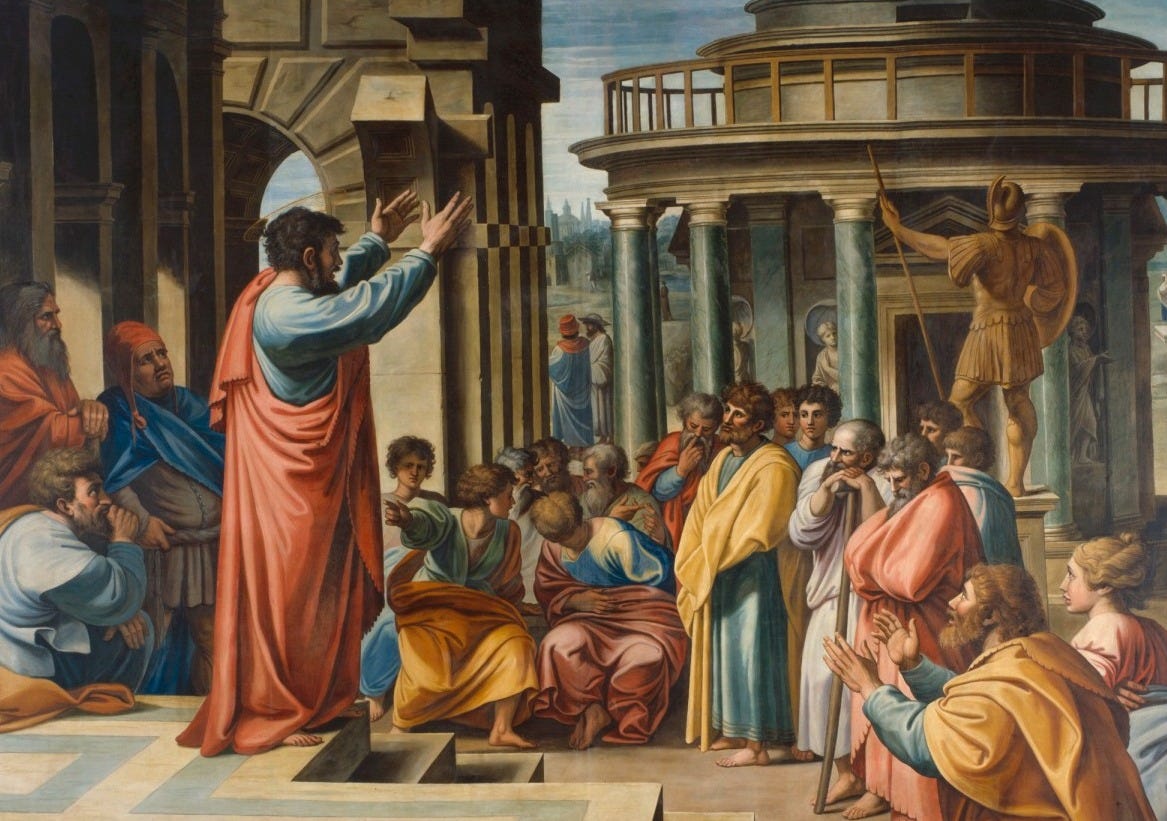
300 - 650 AD: The next age of the Church kicks off with the victory of Constantine at Milvian Bridge. The Roman Emperor then granted religious freedom to the growing number of Christianity via the Edict of Milan in 313 AD, leading to an acceleration of conversions throughout the empire. Further this age reaches new heights through the many spiritual and theological writings of many Church Fathers, such as St. Augustine. This age declines with the political decline of the Western Roman Empire by the many invasions of barbarian tribes and culminates in the conquest of Jerusalem in 643 AD.
Third Age: Carolingian Era
650 - 1000 AD: The Third Age of the Church began with the conversion of formerly pagan tribes of central and western Europe, most notably the Franks. Clovis I became a greater defender of Catholicism and aided its spread in the region, as did his descendants in the Merovingian dynasty. The age climaxed with the rise of Charlemagne in central Europe, who oversaw the Carolingian Renaissance and formed the basis of the Holy Roman Empire. Church and State ruled together in this age. After his death, the age entered a period of decline due to external threats (e.g. the Magyars to the East, Vikings to the North), and the empire for a time appeared finished.
Fourth Age: Medieval Reign
1000-1500 AD: The next age began with the humble monasteries, particularly the renewal of monasticism forged at Cluny in 910. Reforms swept through the Church under the papacy of Gregory VII in 1073. Then, the 1200s saw the pinnacle of Medieval spirituality, thought, and culture with the rise of Scholasticism, the synthesis of Christian and Aristotelian thought. Further, the well-known mendicant orders of the Franciscans and Dominicans were birthed, and many of the great Catholic universities emerged. Unfortunately, the greatness of the age stagnated in the face of increasingly difficult political realities, the Black Death, and finally the winds of change in the Protestant Reformation.
Fifth Age: Reformation & Rationalism
1500 - 1750 AD: Out of the turmoil of the Protestant Reformation in the 1500s, a great renewal of the Church began to take shape. The Catholic Reformation addressed many of the grievances that spurred the Protestant Reformation and brought many back to the fold. Additionally, orders like the Jesuits were founded to help in the efforts of re-conversion. However, the heights of this era were never near those of the previous age. The effects of rationalism and the Enlightenment spelled dark times for the Church (and all Christianity) ahead. Philosophically, politically, spiritually, the Church entered a new low point in the latter 18th century.
Now, we turn to our age, the sixth age of the Church, where modernity is reconciled or conquered with Christianity…
