

Oligarchy is inevitable.
No, this isn’t hyperbole — elites are essential for all human organization. At least, that’s what many of the West’s greatest thinkers have concluded.
The need for a hierarchy, with a few exceptional men at the top, seems to be universal no matter which governmental system a culture implements. From ancient Greek city-states to modern nation-states, all societies are seemingly steered by the decisions of a few.
Here’s why “power to the people” is a myth…
Reminder: You can support us by unlocking our members-only content:
✔️ Exclusive articles every Tuesday
✔️ The entire archive of content: Western history, literature, and philosophy
✔️ Members-only features like community posts and chat
Join to start reading and support the mission today 👇
Ship of Fools
The great Greek philosopher Plato laid out a famous critique of the various governmental forms in Book VI of his work The Republic, which later philosophers like Aristotle built off of.
In it, Plato compares five forms of government: aristocracy, timocracy, oligarchy, democracy, and tyranny. After dissecting each one, the philosopher lands on aristocracy as the best. This might be a surprising pick to modern ears — many would likely choose democracy as the best form given its near-religious veneration in the media and popular culture.
But according to Plato, democracy has a unique flaw in that it leads to an “excessive freedom” which allows the most selfish person to attain power. Though democracy supposedly gives citizens a fair choice, it really just preys on the ignorance of the masses.
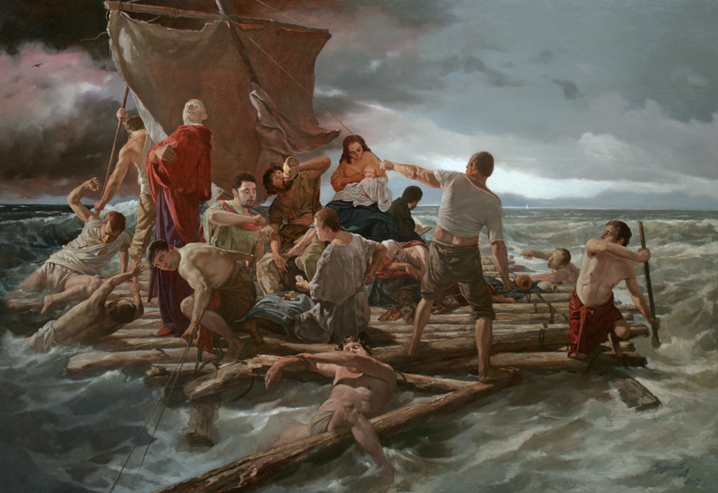
Plato’s critique is via analogy, where he compares the state to a seafaring vessel filled with a group of largely ignorant men — a “ship of fools.”
The owner of the ship is the strongest figure, but is slightly deaf and has a poor sense of navigation. The sailors under his leadership are divided. They argue endlessly over who should control the helm though none are knowledgeable in the art of sailing.
The sailors band together and convince the owner to hand the ship over to them, whereupon the one who is most convincing wins the bid to become the lead navigator. It won’t end well for the ship because the one who now leads doesn’t know anything about sailing — he just has a silver tongue.
The most persuasive man gets the power, so did the people really get a fair choice? Who is actually in control — “the people” who were duped, or the manipulator? And were there other forces who helped the manipulator persuade the masses?
Though Plato didn’t necessarily mean to, his analogy hints toward a concept called “elite theory”...
Origins of Elite Theory
Simply put, elite theory seeks to explain power relations within a society. Its basic form posits:
power in large societies is concentrated at the top in a relatively small group
power flows top-down from elites to non-elites
the actions of elites determine major political & social outcomes
Plato’s countrymen Polybius, writing in the 2nd century BC, described a forerunner to elite theory in his “anacyclosis,” which described how governments — monarchy, oligarchy, and democracy — eventually devolved into authoritarian forms due to corruption.
But the idea that elite rule is inevitable in all forms of government was mainly promulgated by the late 18th & early 19th century Italian School of Elitism, made up of the sociologists Vilfredo Pareto, Gaetano Mosca, and Robert Michels.
The Italian School saw elitism as intrinsic to human society because the psychological differences between elites and non-elites were so stark — the two groups were simply built differently.
Pareto in particular championed the idea of inequality between elites and non-elites. His famous “Pareto Principle” argues that the vast majority of productive labor in any given field is accomplished by only roughly 20% of the population; the other 80% are mostly spectators.
And he believed regime changes were not the result of the people rising up, but rather one elite replacing another in a “circulation of elites.” Ordinary people were just followers like Plato’s sailors who were duped into supporting the most conniving man as captain.
The Iron Law of Oligarchy
Robert Michels followed in Pareto’s footsteps, promoting his theory, the “iron law of oligarchy,” which further emphasized how elite rule was universal in supposedly democratic systems. In his 1911 book Political Parties he asserted that the complexities of large organizations demanded oligarchy as the only viable means of control.
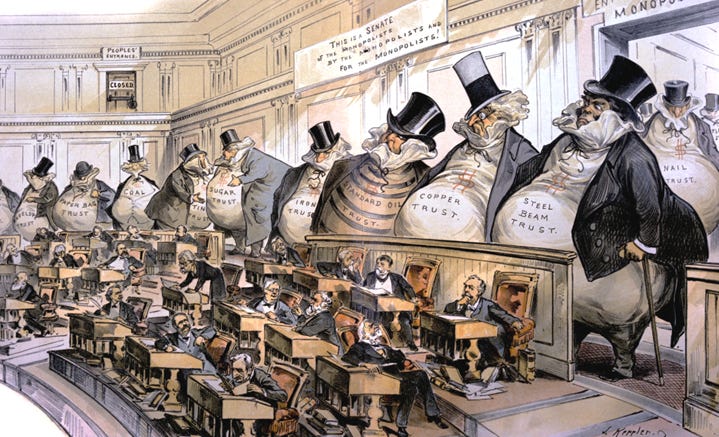
He observed that, since direct democracy is unworkable in complex organizations like governments, power always gets delegated to individuals whether they are elected or not.
Essentially, organization is impossible without a form of oligarchy. He writes:
“It is organization which gives birth to the dominion of the elected over the electors, of the mandataries over the mandators, of the delegates over the delegators. Who says organization says oligarchy.”
Any attempts at true democratic control of an organization will inevitably fail, since the oligarchy in place can reward loyalty, control information, and dictate procedures — mechanisms the oligarchy uses to direct the outcome of any “democratic” resolutions.
But oligarchies have not always been viewed as inherently corrupt or negative…
