

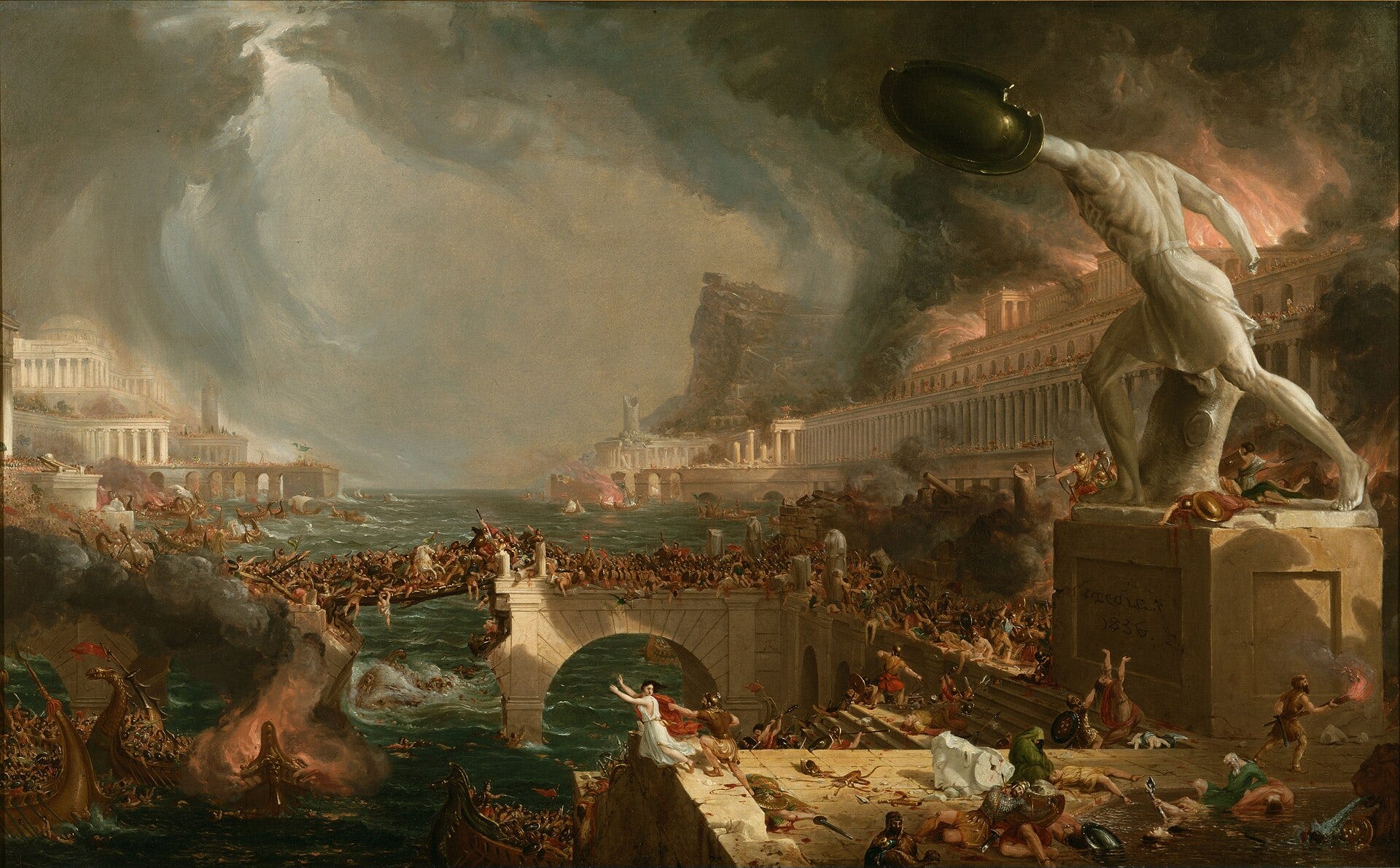
All empires repeat the same cycle, claims 20th-century historian John Glubb. He observed that for the past 3000 years, nearly every civilization has followed the same 6 stages before decline…
His theory isn't new — ancient Greeks like Polybius and Plato along with later scholars like Ibn Khaldun and Giambattista Vico all observed the cyclical nature of civilizations. But Glubb, a former British general turned scholar, formulated a particularly prescient version of the theory in his 1978 essay, The Fate of Empires.
In it, Glubb draws from his study of 11 distinct cultures and creates a template for civilizational development. Ultimately, though, he arrives at a revelation about why we should approach history with a much broader view…
Reminder: You can support us by unlocking our members-only content: in-depth articles and breakdowns of the great figures and ideas that built Western Civilization.
Join to start reading and support the mission today 👇
From Birth Until Death
One of Glubb’s more striking claims is that empires generally only flourish for about 250 years, or 10 human generations, whereupon they begin to decline. He cites the Assyrian Empire (859-612 BC), the Roman Empire (27 BC -180 AD), and the Spanish Empire (1500-1750 AD) among others. Notice that Glubb’s conception of decline does not necessarily mean destruction — the decline of Rome, for example, began with the death of Marcus Aurelius in 180 AD.
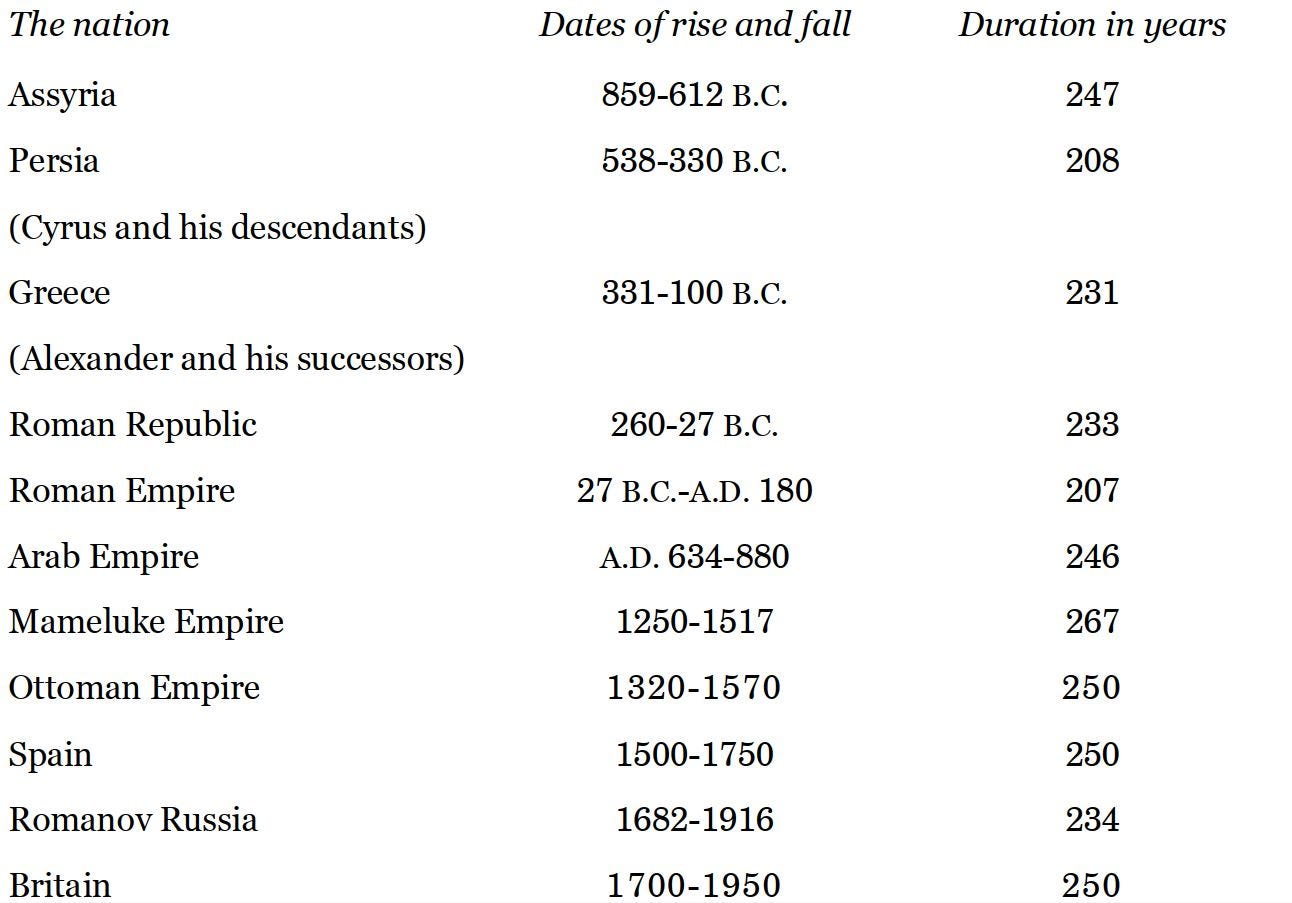
Though there are exceptions, a remarkable similarity in life spans emerges when one compares empires side-by-side:
“In spite of the accidents of fortune, and the apparent circumstances of the human race at different epochs, the periods of duration of different empires at varied epochs show a remarkable similarity.”
One might assume that technology might act as a disrupting force in cultures, and distort this seemingly rigid lifespan. But this is not the case — despite widely varying technological levels, empires conform to the 250 year period with remarkable consistency. Glubb notes that the Assyrians “marched on foot and fought with spears” while the British had artillery, railroads, and steam ships, but the two empires lasted for about the same time.
The Stages of Empire
Glubb didn’t just analyze empires on a superficial level; he broke down their lifespans into 6 distinct stages or “ages,” each revealing a unique cultural ethos for the given period.
The Age of Pioneers
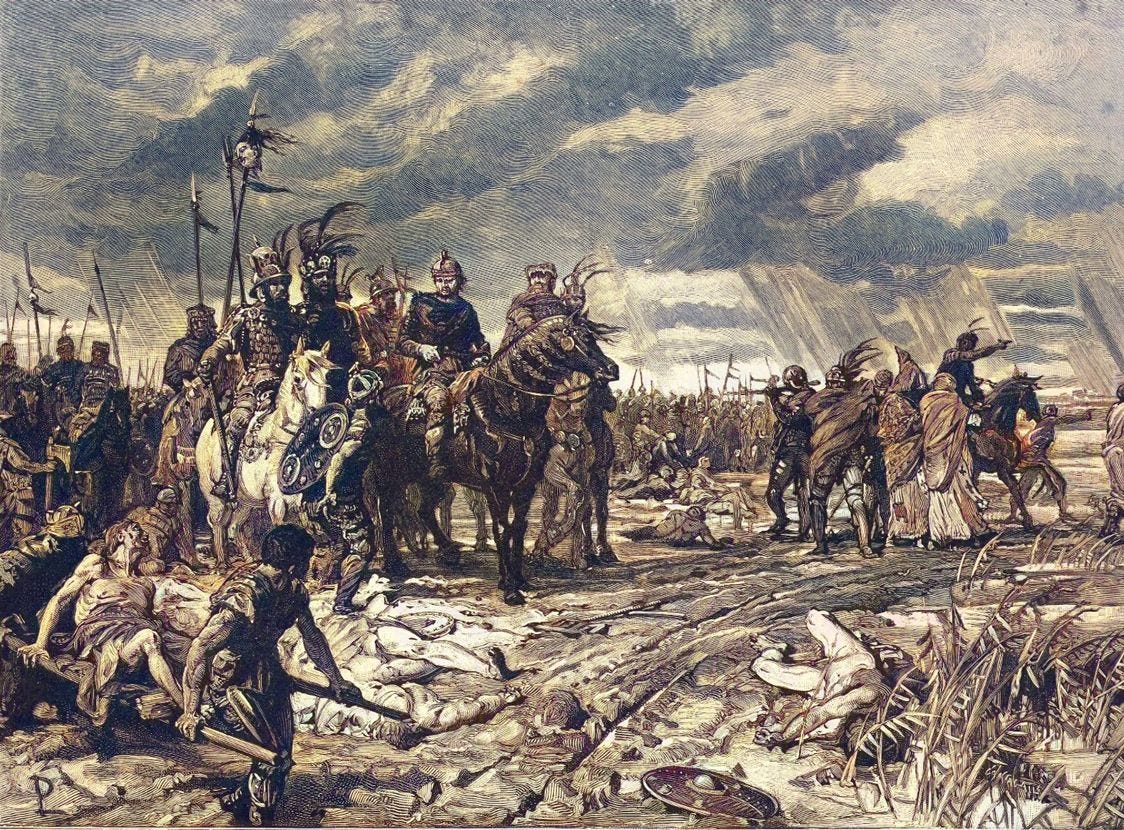
The first stage of an empire, Glubb claims, is the Age of Pioneers, or “the outburst”. This is where a small, seemingly insignificant nation emerges from its homeland and establishes a presence on the world stage. This outburst is characterized by energy, courage, and creativity.
Glubb describes the new conquerors as “normally poor, hardy and enterprising and above all aggressive.” Unbound by established traditions, they rely on improvisation and experimentation, willing to try new approaches to solve problems.
Macedon under Philip II in the 4th century fits this mold:
“Prior to Philip (359-336 B.C.), Macedon had been an insignificant state to the north of Greece…Yet by 323 B.C., thirty-six years after the accession of Philip…the Macedonian Empire extended from the Danube to India…”
The Age of Conquests
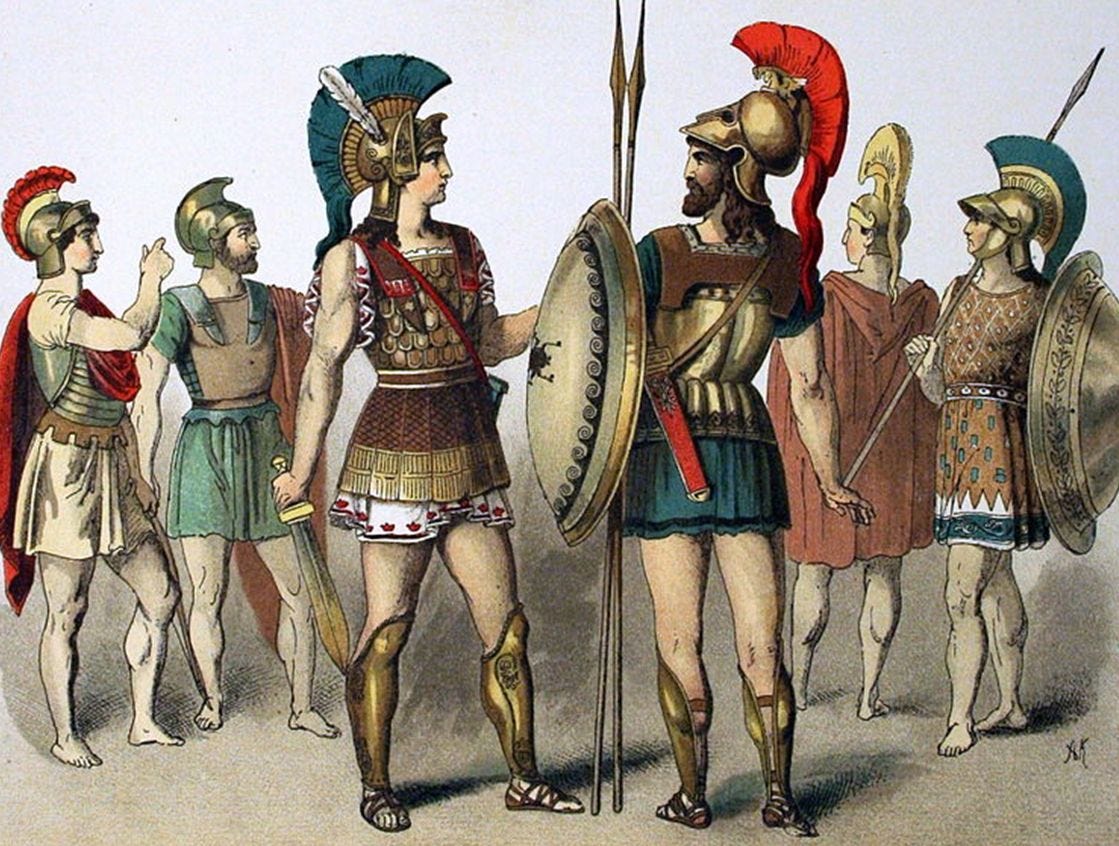
The second stage is called the Age of Conquests. Here, the sophistication of aging civilizations is adopted by the rising power. Thus their expansion consists of “organised, disciplined and professional campaigns.”
This is where the culture becomes a bonafide “empire,” and is characterized by confidence, optimism, and contempt for “decadent” cultures whom they’ve conquered. The people of the new empire are practical in both government and war. Moreover, Glubb notes that their lack of tradition allows their leadership a freedom to continue trying new things:
“...the leaders are free to use their own improvisations, not having studied politics or tactics in schools or in textbooks.”
The Age of Commerce
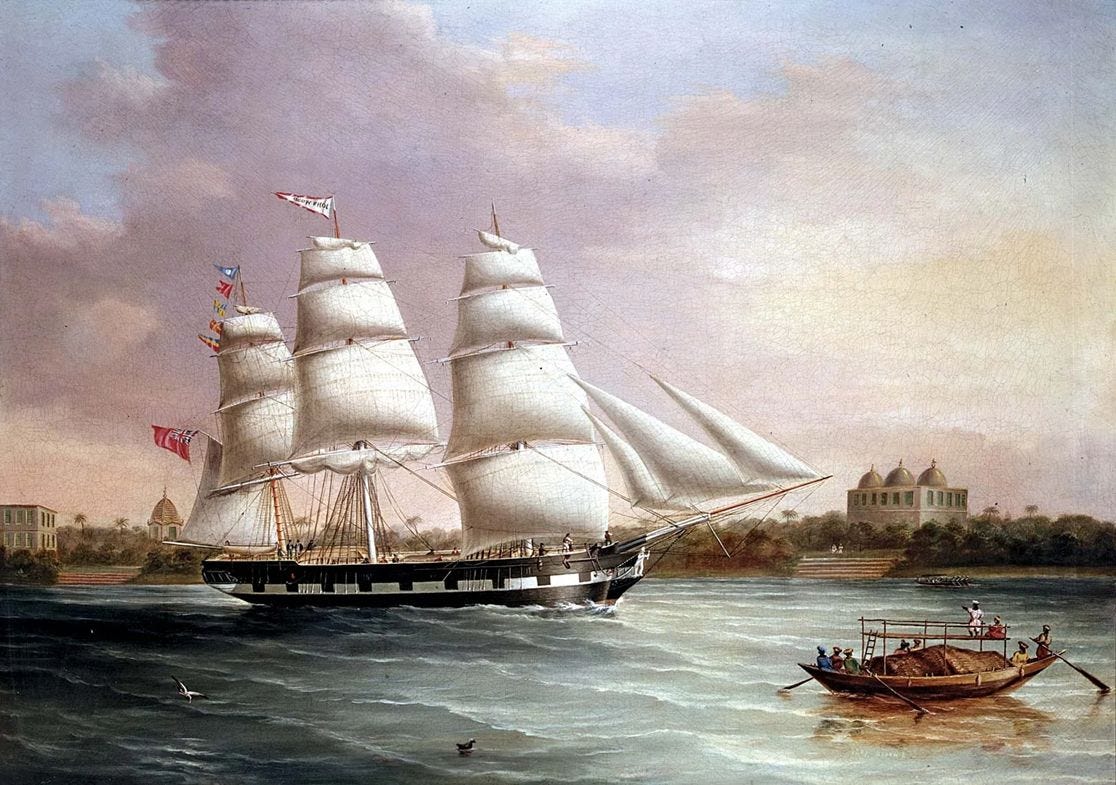
Next comes the Age of Commerce. With the acquisition of vast areas of land, commerce becomes easy and safe for the empire’s citizens. Resources, people, and ideas are exchanged over great distances. And if the empire is large, a great variety of products are produced.
The Age of Commerce often overlaps with the Age of Conquests, but is differentiated by a shift in values:
“The proud military traditions still hold sway and the great armies guard the frontiers, but gradually the desire to make money seems to gain hold of the public”
Honor culture is replaced by a mercantile one. Previously during the Age of Conquest, military glory and honor were the highest values, but in the Age of Commerce, these ideas are but empty words to the merchant who remains fixated on his bank balance.
The Age of Affluence
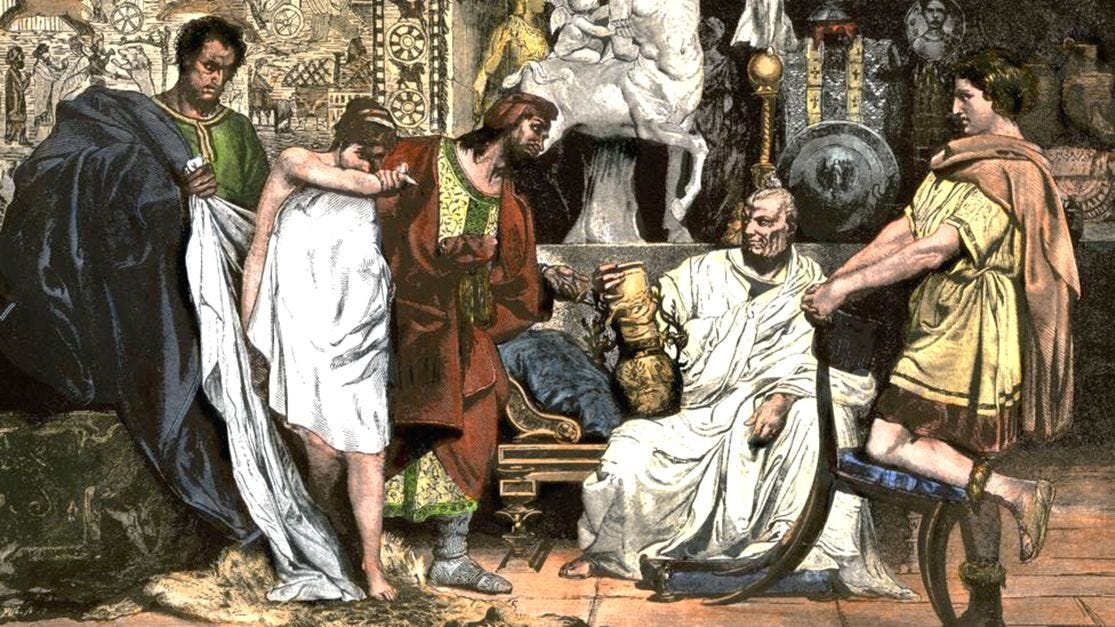
The Age of Affluence follows, and is a natural consequence of the Age of Commerce. Monetary gain becomes the sole pursuit as the energy of the youth, previously fixated on patriotic ambition, devotes itself to the pursuit of cash.
