


If there’s any current trend that absolutely terrifies me, it’s the complete breakdown of marriage and the family.
It’s no secret that marriage and relationship rates are in a freefall. A recent poll showed that around 60% of men under 30 are still single. Women are a little better off, but still not pairing up at historic rates.
And this generation isn’t forming households at all. Less than 15% of adults under 30 are both married and own a home. Compare that to nearly 50% just a few generations ago and you’re looking at a massive decline. More young adults now live with their parents than with a spouse.
So what’s going on?
Well, part of it is economics. Wages have pretty much stagnated for young men in the workforce and housing costs have grown way faster than incomes, so the financial threshold to start a family has become out of reach for millions.
But at the same time there’s a cultural component. Recent polling shows that young women’s desire to marry has dropped significantly in a short period. For the first time in modern history, young men are actually more likely to desire marriage and children than young women. Men feel economically dispossessed and therefore struggle to provide; women feel that traditional partnerships offer no upside.
I believe this trend has potential civilization-ending consequences. How can we survive if such a basic aspect of society, the ability to get married and start a family, is no longer a priority — or a possibility — for millions?
To understand where we’re at now, we need to look back to a time that remains a haunting warning to the modern West. We’ll discover why, as marriage and family formation disintegrate, literally everything — our politics, culture, and economics — will only get more and more insane.
Because when people have no stake in the future, society gets reckless…
Reminder: You can support us in forming minds and rebuilding the West by unlocking our members-only content:
✔️ Full premium articles every Tuesday
✔️ The entire archive: Western history, literature, and culture
✔️ The Great Books lists (Hundreds of titles that influenced Western thought)
Join to start reading and support the mission today 👇
The Cell of Human Civilization
But let’s first start with the basics: why is the family the cornerstone of society? And why is civilization absolutely dependent on the health of the family?
These questions go all the way back to the ancient Greek philosopher Aristotle. He believed society couldn’t even exist without the family. Aristotle outlines in Book I of his work Politics that there is natural human hierarchy that emerges in even primitive societies. The family unit comes into existence because it allows the most basic survival needs to be met and it allows for a small amount of organization to develop.
The family to Aristotle was a microcosm of how the state should function. In a patriarchal society like Greece, Aristotle saw the husband and father as the natural leader. As a king rules over his subjects, so the father would rule over his household.

The relationships found within the family then extend into a village structure where people can achieve broader material flourishing and social complexity. Finally, the relationships found in a village extend into that of a city, or polis, which contains the necessary organization to allow citizens to achieve the full spectrum of human activity — art, culture, government, organized defense.
Without the family, then, you get no village, and no city. No organization higher than the fractured individual. No civilization.
The great medieval philosopher Thomas Aquinas arrived at a similar conclusion. He understood the family as the natural and foundational building block of human society that precedes the political state in development. Like Aristotle, Aquinas saw the family as rooted in nature – the drive to procreate and the need to share survival responsibilities first created the family, and the household came into existence long before any organized political community. This means the government, states, and nations all depend upon and require the family’s existence.
Zooming out from philosophy for a bit, we can see this on an interpersonal level. The family is where the first real transmission of what we call “civilization” actually happens – values, stories, cultural norms, and faith are handed from one generation to the next.
Every child born into a family learns what it means to have a place, a role in this little “tribe” —to be a part of something larger than themselves. To be a part of society. A family, then, is a little microcosm of the larger civilization. Perhaps Pope John XXIII said it best when he wrote: “The family is the first essential cell of human society.”
Now, this begs the question: what happens when families can no longer form? What happens to a civilization when these “essential cells” break down — when men and women don’t ever get married to create them in the first place?
Rome: Economic Woes and Family Struggles
Ancient Rome provides endless parallels to modern society, and it also gives us an example of our present situation regarding the decline in marriage and family formation. Just like today, there were basically two elements to the problem, one economic, and the other cultural.
To make a long story short, near the end of the Roman Republic, , around the 1st century BC, Rome had stratified into two distinct groups: 1) the dispossessed, landless lower classes; and 2) the ultra wealthy.
For most of Rome’s history, its economic backbone was the small, landowning farmer. Their ownership of land was key because it provided the economic means to start a household – to attract a wife and provide for children while providing needed goods for society.
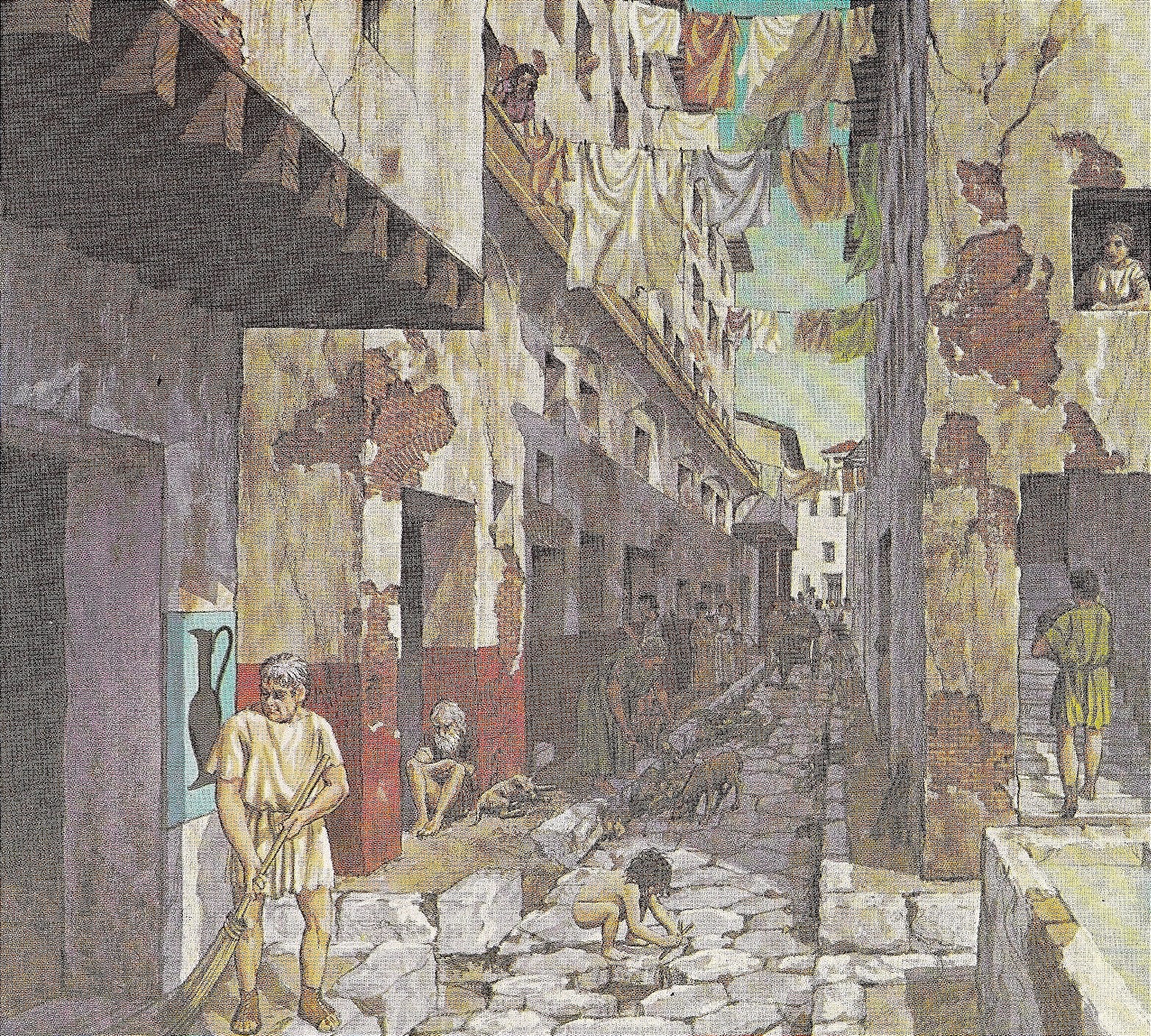
But around the 2nd century BC, a major shift destroyed this class. As plunder from Rome’s incredible physical expansion allowed the wealthiest Romans, the patricians, to buy up large swathes of land, smaller farmers, who were often out at war fighting in these conquests, were left behind.
Their farms were either left in disrepair or were bought out while they were away. At the same time, a massive influx of cheap labor — usually slaves won from conquest — were being used by wealthy patricians to outcompete the small farmers.
This previously independent class of small farmers was basically left with nothing. Their farms were gone, and all the meaningful work was going to newly conquered slaves. With no options left, hundreds of thousands of these displaced rural Romans flooded into the city, becoming the urban poor.
With no land or stable wages, this class — mostly made up of young military aged men — could not meet the economic threshold to form households and create stable families. A family was no longer an economic asset like it was on a farm, but rather a huge financial liability for them living in an urban slum.
Even for those that wanted to get married and start families, the economic conditions made it difficult. Without land, these lower-class veterans and farmers lacked the financial security to offer a dowry, establish a permanent home, or ensure their children had food on the table.
Decadence Leads to an Abdication of Responsibility
As economic power was being ripped from the lower class, patricians were living in a completely different world. They were wealthy and had limitless options for entertainment and revelry. In this type of environment, the long-established norms that dominated Roman society gave way to decadence.
Traditionally among the aristocratic classes, marriage was seen as a duty — it was often an alliance between families to generate legitimate heirs and strengthen the political and social positions of the families involved. Strict monogamy was therefore essential.
However, as the patricians grew extremely wealthy and their power grew unchecked near the end of the Late Republic, their decadence got out of hand. Patricians knew it was a duty to get married and have children, but this was increasingly being delayed or even disregarded in favor of unofficial or casual partnerships that didn’t produce any legitimate heirs. It was simply a lot more fun to forego one’s family obligations.
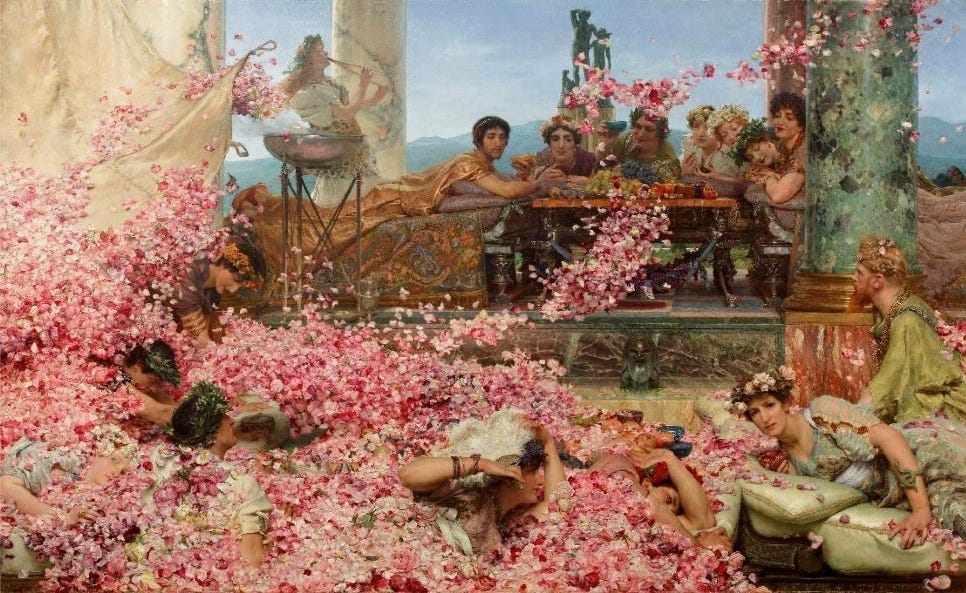
This trend resulted in a depleting pool of patricians. The wealthy weren’t reproducing at replacement levels — so much so that politicians implored the elite to finally settle down. In 102 BC, the censor Metellus gave a speech trying to compel the Roman elite to marry and produce children. He argues that marriage is unpleasant and restrictive, but ultimately one’s civic duty:
“If we could survive without wives, Romans, we would all stay free of that nuisance. But since nature has arranged things so that we can neither live comfortably enough with them nor live at all without them, we must look to long-term well-being rather than short-term pleasure.”
So now we see that both economic and cultural factors were hollowing out Roman families during this time. The question is, what happened after? Did Rome ever recover?
Well, remember how I talked about how the family was where civilizational values and norms were handed from one generation to the next? It was precisely this function that had broken down, meaning a negative feedback loop had been created…
