


We live in an age of pure convenience — an age where human effort has, in some sense, been conquered. But what feels effortless to us as end consumers belies an extraordinarily complex underbelly. Every one of our comforts rests on immense networks of human beings: systems built, maintained, and advanced by millions of minds working in coordination.
This complexity has a cost, too. As civilizations grow, they do not simply become more advanced; they also become more dependent. More people build more infrastructure. More infrastructure enables more comfort and interdependence. That interdependence allows for further specialization, and specialization produces still greater complexity.
But there is a second half to this equation.
As civilizations become more complex, they require more people to sustain them. A small society can remain simple, but a large one can’t. Modern life is not something a small group could recreate or even maintain. Then, every leap in technology requires a critical population to achieve it. For example, the modern semiconductor fab could never be built by a thousand-person village. Ninety percent or more of that village would be farmers or hunters simply to survive. Only sufficient scale can advance civilization.
And that raises a question we have only recently begun to recognize: what happens when the number of people begins to fall?
Reminder: You can support us in forming minds and rebuilding the West by unlocking our members-only content:
✔️ Full premium articles every Tuesday + Free content Thursdays
✔️ The entire archive: Western history, literature, and culture
✔️ The Great Books lists (Hundreds of titles that influenced Western thought)
Join to start reading and support the mission today 👇
The Scaling of Civilization
The smaller the society, the more self-sufficient it tends to be. The earliest human groups — small, nomadic bands — lived close to the edge of survival. Most members contributed directly to food, water, shelter, and defense. There was little room for specialization because survival demanded nearly everyone’s full attention.
These societies were resilient in the sense that they were insular. Their smallness allowed them to move and adapt to local crises, but it also limited their ability to develop complex systems. There were no spare hands to build them. Even today, the pattern holds: the more isolated a family becomes, the more its time must be devoted to survival.
As populations grew into the thousands, agriculture emerged (or perhaps more accurately, enabled that growth). This was not merely a dietary change, but a civilizational one. Farming required permanence, and permanence demanded coordination. In the Nile River Valley, irrigation cycles required shared labor and timing; in Mesopotamia, early cities like Ur depended on grain storage and redistribution to function.
Most importantly, agriculture introduced surplus, and surplus introduced specialization. Not everyone needed to farm anymore. A portion of the population could instead craft tools, organize governance, conduct trade, or shape religious life. For the first time, societies could sustain roles dedicated to advancement over mere survival. Complex civilizations required numbers.
Classical Civilizations
This trend toward increasing non-survival labor reached new heights in the classical world.
The early Greek city-states (not forgetting the Mycenaeans as a critical precedent), some numbering in the hundreds of thousands, developed systems of governance, philosophy, and military organization that still shape the world today. Their scale allowed for many thinkers, soldiers, artisans, and administrators, each of these categories with their own slew of subcategories. They reached a societal complexity that no single individual could fully comprehend in all its moving parts.
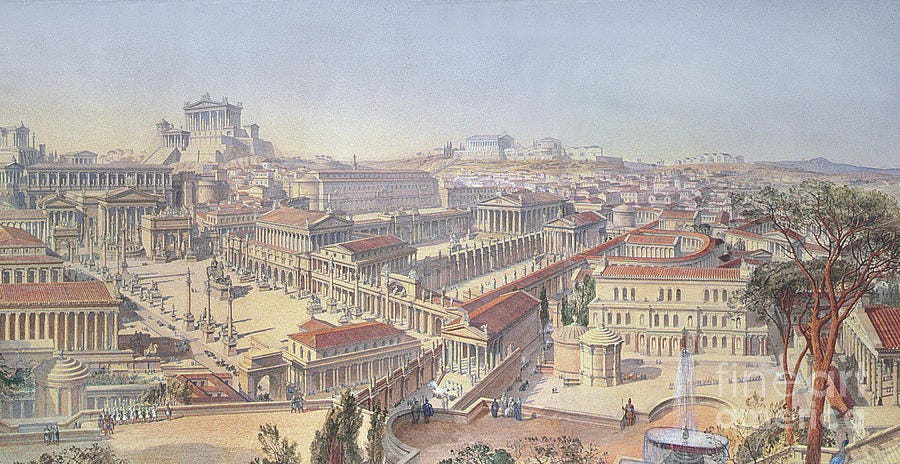
Rome only brought that complexity to new heights, to awe the world not only in its complexity but most acutely in applying that complexity across such a vast territory: a true pan-continental empire.
At its height, Rome governed tens of millions. Its roads stretched over 250,000 miles. Its aqueducts delivered running water into cities like Rome itself, which likely exceeded one million inhabitants. Grain shipments from Egypt fed the capital, while legions secured borders from Britain to the Near East.
None of this was accidental, nor natural, because the building and shaping of our environment in ways never before seen is a hallmark of humanity. Humans question, imagine, and create — not merely repeat patterns as other creatures do.
Back to Rome, it took generations of engineers, laborers, soldiers, and administrators all operating within a system so vast that its stability depended on constant maintenance. Food could not stop being produced while aqueducts were being built. The soldiers could not stop defending the Roman borders while the Colosseum was constructed.
All parts of the society were intertwined, and if just one thread were pulled loose, even a civilization as mighty as Rome could — and did — collapse. The belief that Rome was invincible was no different than the claim that the Titanic was unsinkable: there is no true law of “too big to fail.”
In its later days, populations declined, trade networks fractured, and infrastructure deteriorated. Without the maintainers of a complex society, a civilization reverses into simpler modes of existence. The “dark ages” were not primarily the result of religious backwardness, but of fragmentation: political, cultural, and demographic. As unity dissolved, so too did the ability to sustain large-scale systems.
Complexity is contingent; it exists only so long as there are enough unified people to sustain it…
