

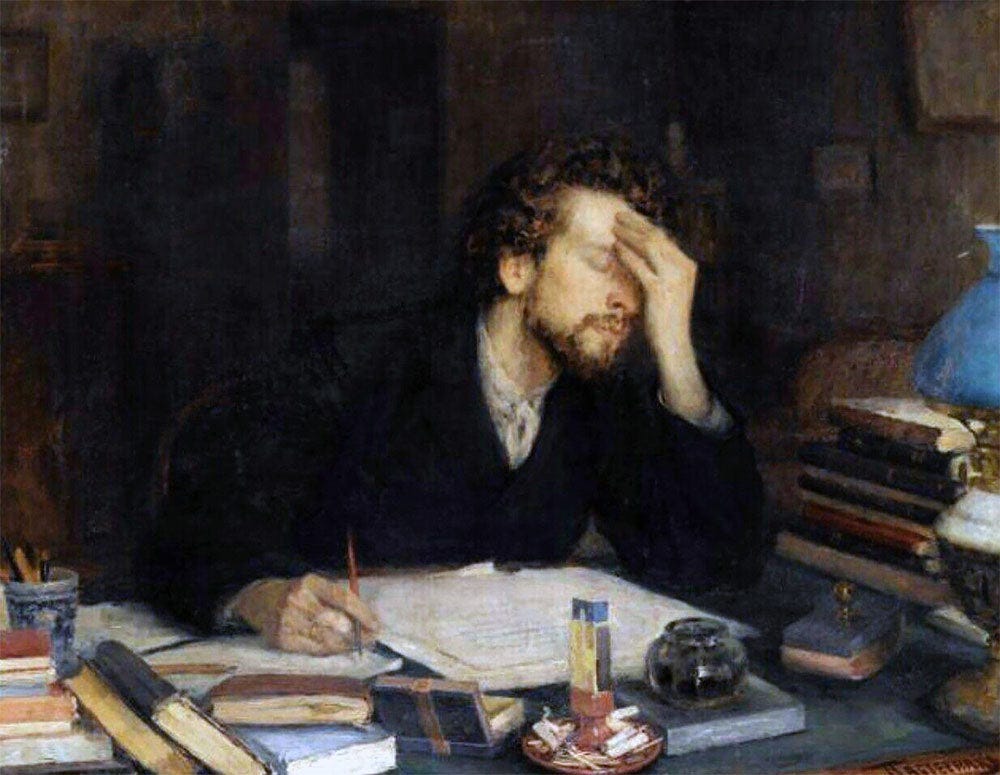
What are you doing with your mind? Ancient thinkers have been concerned with that question long before the advent of mindless scrolling on social media.
For most of Western history, how the mind was being used was central to the philosophy on living a good life. The quality of your attention was not incidental to who you were, but rather a reflection of your discipline and character.
Past thinkers recognized a duty to exercise your mind, seeing the sin of Sloth as applying equally to the mind and the body. The ancient world built entire disciplines around this conviction. We have built an entire economy — the attention economy — around destroying it.
Reminder: You can support us in forming minds and rebuilding the West by unlocking our members-only content:
✔️ Full premium articles every Tuesday + Free content Thursdays
✔️ The entire archive: Western history, literature, and culture
✔️ The Great Books lists (Hundreds of titles that influenced Western thought)
Join to start reading and support the mission today 👇
Wisdom of the Philosophers
Plato recognized the impact of what we think about and how it affects our soul in Book VI of The Republic:
“The soul is like the eye: when resting upon that on which truth and being shine, the soul perceives and understands and is radiant with intelligence; but when turned towards the twilight of becoming and perishing, then she has opinion only, and goes blinking about.”
Typical of Plato, this is a metaphysical claim — that the inner life is not a fixed thing but a dynamic one, continuously shaped by whatever it is allowed to dwell upon. The soul, for Plato and for virtually all subsequent Western ideas, was something being formed, moment by moment, by the direction of its own gaze.
This wasn’t simply an abstract conviction confined to the circles of the philosophers, either. Instead, it shaped how the Greeks organized education. The paideia, the classical formation of the young, was built on the premise that what a child was exposed to, what stories he heard, what music he absorbed, what images surrounded him, would form him at a deeper level than instruction. Plato famously wanted certain poets (not all of them) censored from his ideal city because he thought Homer’s gods, quarrelsome and petty, were shaping the souls of Athenian boys in the wrong direction. Even the enemies of Socrates argued for his condemnation on allegations of poisoning the minds of the youth with his ideas. The Greeks were particularly sensitive to the intellectual influences on their youth, because they recognized their power in shaping whole generations.
Marcus Aurelius returned to the same conviction in the Meditations, a private journal never intended for publication, written while campaigning on the Danube frontier:
“Your mind will be like its habitual thoughts; for the soul becomes dyed with the color of its thoughts.”
Marcus was reminding himself, in the midst of war and administration, that the interior life required its own discipline.
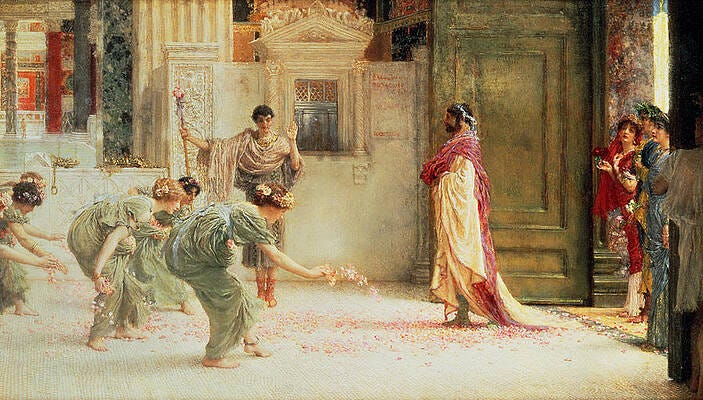
Aristotle went further, arguing in the Nicomachean Ethics that contemplation was not merely a useful habit but the highest activity available to a human being, the one most fully expressing what we are. To be chronically distracted, in this framework, was not merely to be inefficient in the modern sense that everyone believes they have ADHD. It was to fail at being human in the most fundamental sense — a failure to truly live.
Engineered Attention
Against this classical backdrop, we question (to Aristotle’s point) whether modern man is really living at all. Our attention today is ruled by screens, apps, and social media feeds. The last is a comical term, as we’re clearly being fed content, like hogs to grain.
The attention economy is not a neutral development or an inevitable consequence of technological progress. It is an engineered system, built around human attention as a finite resource, and whoever captures it can monetize it. Every feed, notification, and algorithmically-optimized scroll is the product of huge investments and some of the sharpest technical minds of a generation, all directed toward one end: to keep you from leaving.
The mechanisms are now well documented. Sean Parker, one of Facebook’s founding presidents, admitted in 2017 that the platform was deliberately designed to consume as much of users’ time and attention as possible — exploiting the dopamine hit that comes with someone liking or commenting on their post. Intermittent variable rewards like these (the same structure that makes slot machines effective) keep our fingers scrolling instead of powering off our phones. Further, content engineered for outrage and anxiety are privileged in our feeds because these topics hold attention longer than uplifting content. The infinite scroll was designed without a stopping point because stopping points allow people to leave.
While these highly addictive apps have earned plenty of criticism over the years, the bigger questions are typically never asked. The wasting of hours a day in a virtual town center is one thing. But a larger concern of mine is how the constant consumption of short, viral media degrades the capacity for the kind of attention that the ancient world considered essential to a fully human life. Sustained focus, the ability to stay with a difficult text, a long argument, a moment of silence: these skills all atrophy without practice. Older generations raised without these addictive technologies but getting sucked into them later is one thing — they may become rusty on such skill they had in their youth. But what happens when generations are now raised that never attained these skills in the first place? All the later generations will know is an 8 second attention span. A mind trained from childhood to expect constant stimulation might not simply be delayed in the skills of contemplation: I fear they may lose the capability of deep thought altogether.
A New Era of Soft Minds
The losses are harder to see because they are interior.
Aquinas’s Summa Theologica, produced across decades of sustained intellectual labor, was a teaching document. It assumed students who could hold an intricate argument in mind across sessions, return to it, dispute it, and be changed by it. The letters of Erasmus, Thomas More, of later figures like Samuel Johnson and Edmund Burke often contained careful arguments, sometimes running to thousands of words. That organization of the mind has not disappeared because people devolved naturally. It has been dismantled by an environment that rewards speed and punishes depth.

John Cassian, writing in the fifth century, described the wandering of the mind during prayer (what he called logismoi) as the central spiritual struggle of the interior life and prescribed specific disciplines for it. The Desert Fathers, the Benedictine lectio divina, the hesychast tradition of the Eastern Church all built their practice around the same premise that inner quiet was not a natural state but a victory for the contemplative, prayerful soul. The modern person has not escaped that struggle. We have simply lost the disciplines and multiplied the distractions.
Two decades of the attention economy softened the mind’s tolerance for difficulty itself. The capacity to sit with a hard question, to read against resistance, to follow a long argument without relief, quietly eroded through the accumulated habit of always reaching for the easier thing. By the time AI arrived, the ground had already been long prepared by smart phones, social media, and video games.
While AI didn’t cause the crisis of attention, it arrived at precisely the moment when the mind, already softened, was most vulnerable to the offer it presents: hand over the hard work of thinking. The friction that once forced the mind to slow down and actually engage with difficulty has been engineered away. The temptation is no longer merely distraction, but rather complete abdication from challenging thought.
Aristotle’s claim was not that contemplation produces good results, or (by extension) that it will ever outperform AI in terms of efficiency, speed, and completeness. He posed instead that contemplation is a fundamentally human activity. A person who permanently outsources that activity then becomes in many ways less human and more vegetative.
