


You probably have strong opinions about how your country should be run. But do you have a vision for how your own home should be run?
We want a resurgence in civilization of beautiful things, strong families, capable people, and true justice and prosperity — in short, we want renewed confidence in culture.
However, with the U.S. midterms having just concluded, are we satisfied with having merely voted for those principles, or do we actually put it into action in our own lives?
If we want to see our country governed a certain way, we need to first rule our homes in ways that build toward that larger societal vision. We need to rule our homes — kingdoms in miniature — like great kings of the past.
Charlemagne understood that great ambitions required attention to ordinary things. His plans for a Christian empire extended from churches and education to the provisions, tools, and gardens on his estates. His example offers a challenge to us: take responsibility for our own small kingdoms.
Reminder: You can support us in forming minds and rebuilding the West by unlocking our members-only content:
✔️ Full premium articles every Tuesday + Free content Thursdays
✔️ The entire archive: Western history, literature, and culture
✔️ The Great Books lists (Hundreds of titles that influenced Western thought)
Join to start reading and support the mission today 👇
Visions of Greatness
Charlemagne wasn’t great because of conquest. He wanted the lands he ruled to sustain a Christian civilization, with the learning, institutions, and architecture that required.
He had a vision for his kingdom — a big one. His coronation as emperor in 800 renewed the idea of a Christian empire in the West. This was the first step toward the Holy Roman Empire that would later be solidified by Otto.

Charlemagne kicked off governing programs for increased justice, peace, and the protection of the vulnerable. Because he believed learning was necessary to right conduct, as he explained in his letter to Abbot Baugulf, he also launched initiatives to increase education, namely in literacy and the availability of books.
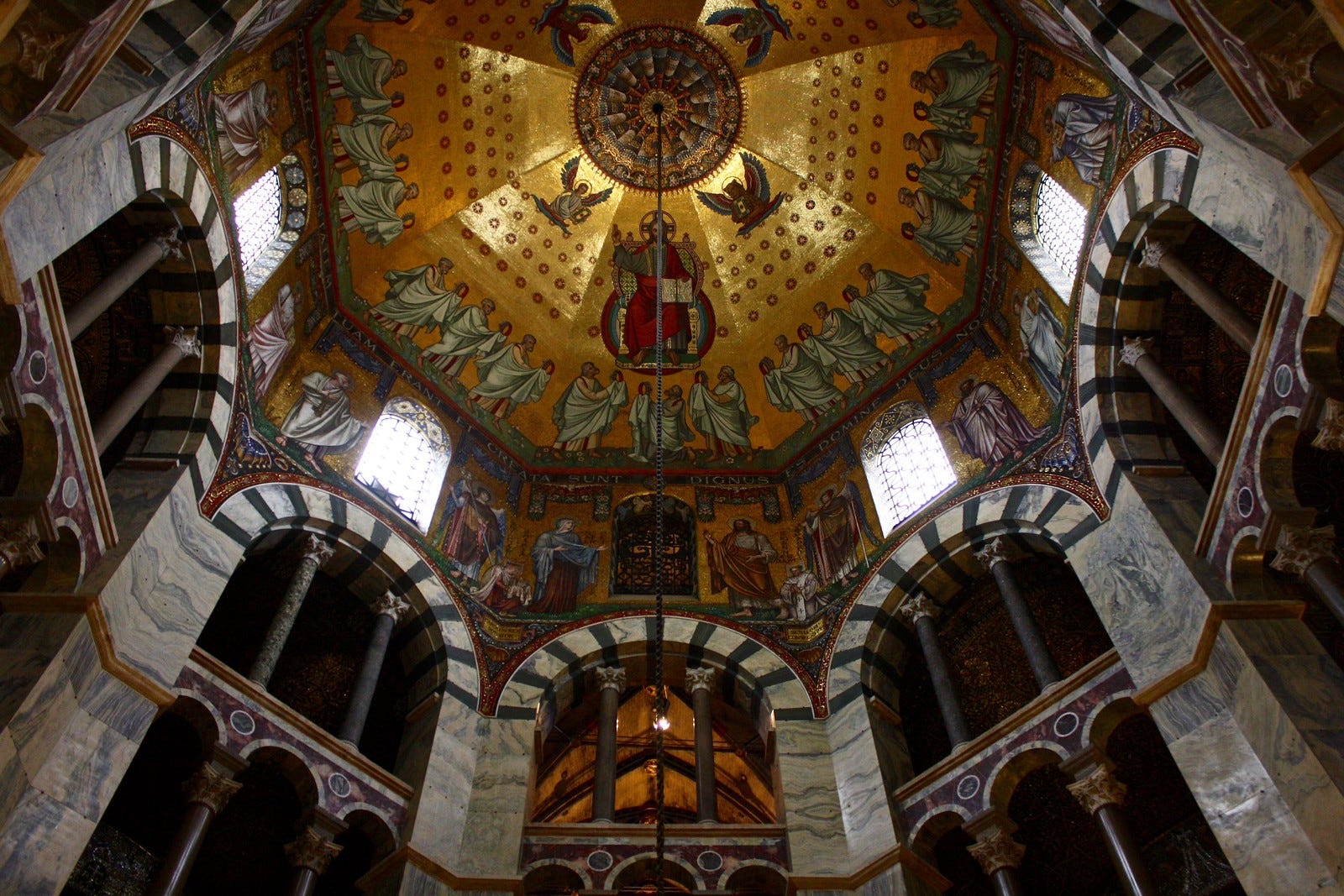
Charlemagne also understood the importance of beauty in his vision. At Aachen, he commissioned the finest church of the era, richly decorated using columns and marble brought from Rome and Ravenna. Elsewhere, he ordered deteriorating churches repaired and sent masons to churches needing repair, to uplift the state of religion in his territories.
Overall, Charlemagne’s vision was a real step toward re-civilizing the world hundreds of years after the Roman Empire disintegrated. But in our own homes, we can borrow from his sense of vision, too.
For many of us, home becomes the place where we recover between obligations. We eat, sleep, wash clothes, and head out again. It’s a practical dump for stuff — the things we acquired because we worked all day at our job. There’s no intention in the home — no goal for what it should be.
The home, especially for young families, is much more than a place to simply accomplish the mundane portions of life. The home is the world in a much bigger way than it seems, especially for kids. The home is the primary place of learning, because parents are the primary teachers of children in the first place. Just as much as we decorate and create our homes, they — through a combination of visuals, sounds, smells, and the conversations and play that happens inside them — affect us. Our homes change us.
Think of when you from childhood: the decor on the walls, the smells around the holidays, and everything in between all have some place in your memory from time to time. This is because your home was a formative place for you.
Knowing that now, we need to approach the home with some intention behind it. What kind of place do you want to spend the majority of your time in? What kind of place do you want your friends to experience when they visit? What kinds of memories do you want your children to have of the home?
This is why we need the vision of Charlemagne. Especially for young families, think about what your home is teaching your children. Does it orient them toward what is true, good, and beautiful? Does it educate them and give them confidence to face the world?
The pictures we hang on the wall, the media they consume, the books they read, the art they experience at home — all these integrate to affect how they think about the world in the future.
Hence, we need to make our homes in the image of what we value most. For many of us, that will be God. Make your home a Christian home. Make it stupidly obvious to the stranger walking in what you hold highest. Your children, friends, and family will see that.
By having a vision for the home, we rule our own kingdoms with similar intentionality to how Charlemagne approached the nascent Holy Roman Empire.
Provide and Protect
Charlemagne also instituted regulations on the management of his estates, requiring bedding, cooking vessels, tools, and supplies to be available at all times. This in turn helped to ensure food was prepared correctly and weapons maintained for times of trouble. Charlemagne’s attention on the details of his kingdom ensured a certain level of respect, but more importantly of readiness.
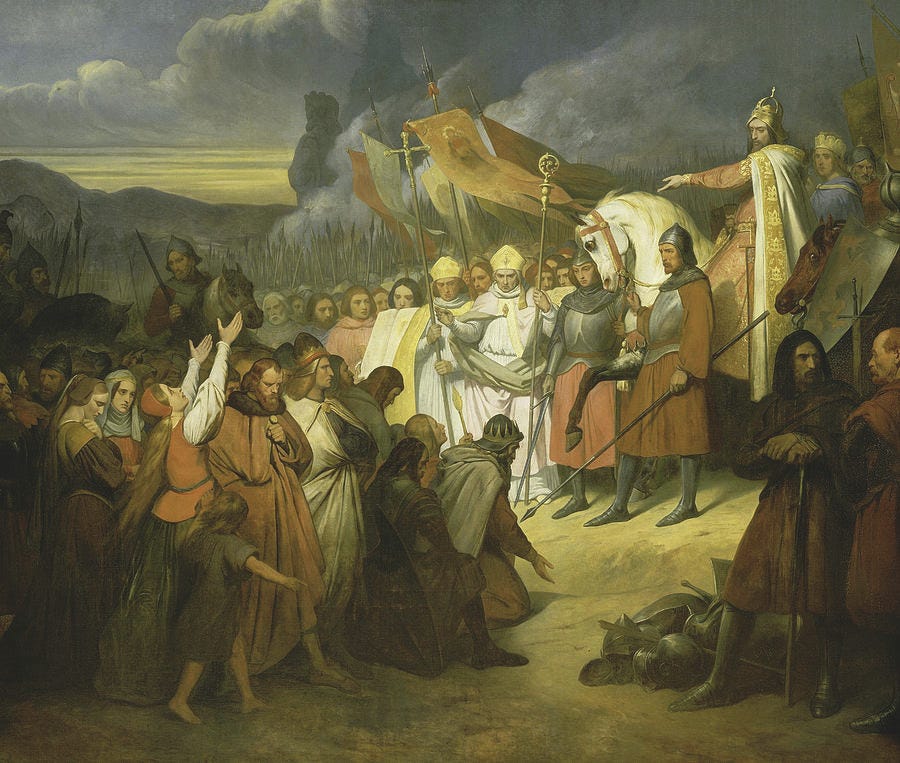
Whether a ruler of a kingdom or of a home, you have to take responsibility for the same essentials: food, shelter, health, finances, maintenance, and protection. This goes without saying for most people, but these are the duties of anyone bearing the primary responsibility of a home. A father neglects his duty to his family if he doesn’t carefully consider the protection of his home. A mother who doesn’t consider the health of the food she feeds her children likewise neglects that same duty. Even single folks in apartments have these duties, of course, though their scope is smaller.
A king, like a head of household, must balance the necessities of the present against those of the future. You need the skills to recognize what’s necessary vs. superfluous, what requires immediate attention as opposed to patience and delegation.
I like to think of my home as a small kingdom entrusted to my care. Its condition matters to me, as do the people and influences I welcome into it. And I have to balance what I build or fix now versus what I can invest in or save for in the future.
The homeowner is a king in miniature; the duties are largely the same, although the size of the kingdom is much smaller. A civilization or nation is stronger when its individual homes are stronger. A resilient and well-run home is a boon to larger society, rather than a liability. And in these small ways of running a home well, we contribute to the greater society a healthy cell in the body of a civilization.
Cultivation
When the practical needs of kingdom are met, only then can a king turn their attention to the finer details of a prospering kingdom. Charlemagne’s estate regulations specified how his gardens were to be cultivated, presumably with beauty and order in mind. His church at Aachen was commissioned as not simply a practical place for Mass, but a beautiful one, too — as best as the relatively primitive masons at the time could muster. Beauty was on the mind of Charlemagne before the Medieval age really even reached its romantic phase. His governance of his kingdom reflects his value for education, God, and beauty, and our mini-kingdoms should, too.
Like Adam in the Garden of Eden, whatever we own — be it land, a small apartment, a car, or anything of minor value — we have a duty to take care of it and improve it if possible. Besides the obvious stated commands of Genesis, an underlying principle of life in that garden was creation. “Be fruitful and multiply,” and I take this not only to mean the having of children, but also in the sense of the stewardship of goods.
Hence, if we own land, we should use it for wholesome purposes: for planting, gardening, restoring neglected spaces, preserving beauty and wildlife, etc. If there’s an ugly room in our home, we try to make it more beautiful. If we have tools in disrepair, we work to restore them. This is difficult in our throw-away culture of cheaply-made goods. It’s not entirely the consumer’s fault either. Many times, what’s affordable is limited in its lifetime and disposable because of poor materials or because complicated electronics are involved.
But to the best of our abilities, like Charlemagne repairing the many churches throughout his kingdom, we should work to make our homes better by living there, even if only temporarily. We should strive to make yards pleasant; we should keep houses in good condition, and we should deliberately look around us to see what we can make better.
When we make our homes more beautiful, the world sees it, too. And that makes our state, nation, and civilization better, too, even if it’s just one grain of sand in the bucket at a time…
