

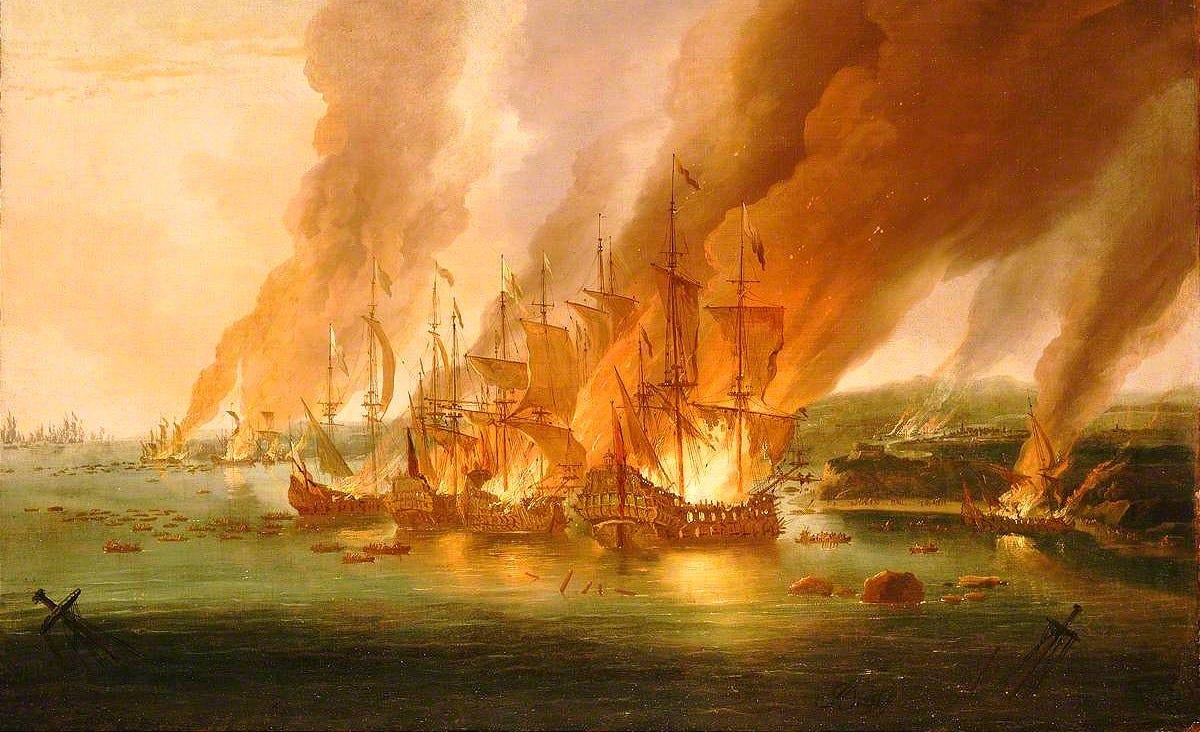
In 1519, Hernan Cortez did something absolutely insane.
Thousands of miles from home, surrounded by enemies on a hostile continent, he gave his men a puzzling order: destroy their own ships. It ended all communication back home, cut off their supply lines, and erased any chance of reinforcements.
But why?
More than anything, Cortez did it so no one would be tempted to retreat. Now his small army had to march hundreds of miles inland to conquer the massive Aztec Empire without a backup plan. The only way out was complete victory.
Cortez and his men understood something that has been completely lost in the modern world: absolute commitment. Think about life today:
We scroll Netflix with thousands of shows and movies, yet struggle to pick one. We get anxious choosing a career path because it feels wrong to limit ourselves to a single interest when there are so many to choose from. We’re afraid to choose the wrong one. And most young people are now single, even though dating apps offer countless potential partners — more options than previous generations ever had access to.
In short, our options are paralyzing us.
So what can we do?
I want to show you why keeping all your options open is probably one of the worst things you can do for your personal growth. Throughout history, some of the greatest achievements happened not because people kept their doors open, but because they purposely closed them.
The great figures of history didn’t have an escape plan — they burned their ships.
No Other Option But to Conquer
When Cortez ordered his men to destroy their ships off the coast of Mexico, it wasn’t a spur of the moment, impulsive decision. Instead, it was a calculated move. And it was during an exceedingly difficult time for the expedition…
Immediately after Cortez’s men landed in Mexico in 1519, they split into two competing factions: those on the side of the governor of Cuba, Diego Velázquez, and those loyal to Cortez. Cortez was technically an outlaw at this point, as Velázquez had revoked Cortez’s command right before the conquistadors set sail. Tensions heightened within the group, who were now caught between the hostile Aztecs, Cortez’s ambitions, and the Spanish crown. Some men thus conspired to mutiny by seizing a ship and escaping to Cuba.
The pressure was on Cortez to unite his men and prevent any thoughts of mutiny, but also to deter retreat by the rest of his men, many of whom were second-guessing the entire endeavor.
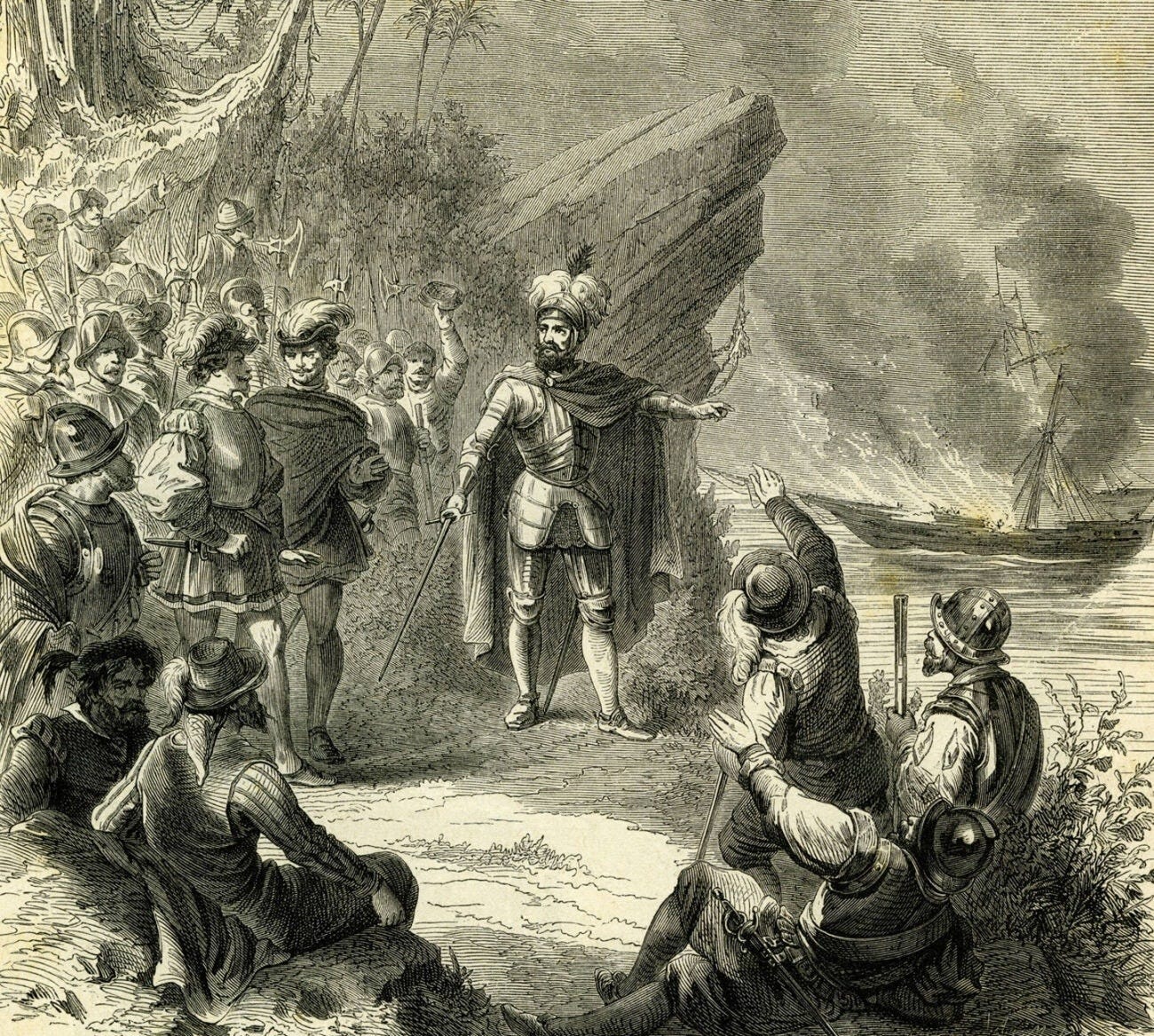
The conquistador Bernal Diaz Del Castillo, a member and direct eye-witness to the expedition, recorded in his work, Discovery and Conquest of Mexico and New Spain, that Cortez made the decision to destroy his ships shortly after consulting with some of his top men on the best course of action:
“This resolution was immediately adopted, and Cortez ordered…to take all the anchors, ropes, sails, in short everything that might be of use to us out of the vessels, and run the latter all on shore, with the exception of the boats.”
And in a letter to the King of Spain, Cortez described later why he destroyed his fleet:
“Believing, therefore, that if the ships remained there would be a rebellion... I devised a plan, under pretext of the ships being unfit for sea, to run them aground.”
One thing I should clarify here is that Cortez didn’t technically burn his ships — that was a myth that came about later. His men actually just dismantled and ran them aground (or sunk them, depending on the source.) Nonetheless Cortez’ actions cut off any possibility of second guessing by himself or his men. After the ships were stripped of useful materials, food, and metals, they were finally destroyed. There was no going back.
Cortez made this reality absolutely clear to his men before going forward with the mission. He wanted his men to fully understand the situation they were now in, and used examples from history to drive his point home.
In Bernal Diaz’s account, Cortez gave a speech where he mentions several heroic deeds from the ancient Romans, and his men compared themselves to Julius Caesar’s army crossing the Rubicon. Diaz writes:
“We answered him, one and all, that we would implicitly follow his orders, as the die had been cast, and we, with Cæsar, when he had passed the Rubicon, had now no choice left; besides which, everything we did was for the glory of God and his majesty the emperor.”
After the ships were destroyed, Cortez went on to lead one of history’s most successful military campaigns, defeating the Aztec empire with just a few hundred Spaniards and a coalition of native tribes. Their absolute commitment resulted in absolute victory.
The First Boat Burner
Cortez’s men alluded to another great leader to have metaphorically “burned his ships”, Julius Caesar, so Cortez’s decision wasn’t a one-off thing. In fact, there’s actually a decent historical precedent for this kind of activity. So let’s go back to long before Cortez and explore one of the very first generals to use this tactic.
In Western history, the first well known leader to use this technique was Agathocles, king of Syracuse in the late 4th/early 3rd centuries BC.

In 310 BC, Syracuse was embroiled in a bitter war against the Carthaginians. They had suffered a series of devastating losses which saw most of Sicily under Carthaginian control, except for the city of Syracuse itself.
With Carthage’s most experienced troops already garrisoned on Sicily, Agathocles hatched a daring plan. Instead of fighting Carthage on home turf, he believed his best bet was to take the fight to them: assault Libya, stir up dissent among Carthage’s allies, and plunder Carthaginian territory.
He thus led a fleet of 60 triremes to narrowly sneak past the Carthaginian blockade and land in Libya. He then set fire to his ships.
And, like Cortez, Agathocles had good reason to do so…
