


Today many feel that the doors are closing on opportunities. Good careers are threatened by AI and robotics. Homeownership seems out of reach for many people whose parents seemed so much further ahead. College looks like an expensive gamble, and upward mobility feels increasingly out of reach. Even dating seems hopeless today. But there’s always a reason to hope — here’s why.
These are all part of the conventional, first-world path, and all accomplished within the framework of existing institutions. Though the problems are real and provable with lots of data behind them, a bigger issue is that we’ve confused broad societal struggles with our own capabilities.
The historical counterexample to our current black-pilled outlook is El Cid. He defied the odds and rose up from situations that seemed hopeless. His trick? Think outside the current institutions. He discovered that his future wasn’t limited to the opportunities given to him. He had to make them.
El Cid was exiled from Castile in 1081, but 13 years later he found himself the ruler of Valencia. Here’s how he did it, even when the world cast him out.
Reminder: You can support us in forming minds and rebuilding the West by unlocking our members-only content:
✔️ Full premium articles every Tuesday + Free content Thursdays
✔️ The entire archive: Western history, literature, and culture
✔️ The Great Books lists (Hundreds of titles that influenced Western thought)
Join to start reading and support the mission today 👇
Rise & Exile
Things started out well for Rodrigo Díaz, later to be called El Cid.
He grew up in a family of minor nobility in the household of Prince Sancho, the son of King Ferdinand I, receiving both a courtly and military education. Later, he distinguished himself during the succession struggles between Sancho and his brothers. Despite his increasing reputation in Sancho’s army, it all fell apart when Sancho was assassinated, leaving Castile to pass into the hands of Sancho’s brother and rival, Alfonso.
Fortunately, at first, all went well with Rodrigo in the new court of Alfonso. He prospered under Alfonso’s rule of Castile and married Jimena Díaz, a relative of the king — a sign that he was still rising in stature. But things started to turn sour when Rodrigo got embroiled in political and military affairs of southern Spain.
The first crack was the Battle of Cabra. At the time, Muslim rulers in Granada and Seville paid tribute to the Christian king in return for protection.
Rodrigo was sent to collect that tribute from Seville, but found himself defending the city from an attack from Granada. While the victory bolstered his reputation as a commander, it also caused tension in the upper circles. Among the attackers and captured prisoners was García Ordóñez, a count who was collecting tribute from Granada at the time.
They were ultimately serving the same king, and this brought Rodrigo into the crosshairs of court politics.

Later, Muslim forces raided the Castilian territory around Gormaz. Rodrigo then took matters into his own hands and led a counterraid against Muslim-held Toledo. The problem was that Toledo’s ruler was also under the protection of Alfonso, who had political interests there. Because of his unauthorized attack, Rodrigo was exiled in 1081.
But like all great comeback stories, this setback was just the beginning.
The Return of El Cid
Once exiled from Castile, Rodrigo offered his service to Zaragoza’s Muslim ruler, where he led victories at Almenar and Morella. His service to the Muslim rulers, besides winning him their respect, also won him his famous name, El Cid. The title comes from the Arabic sayyid, meaning “lord,” which passed into Spanish as Cid.
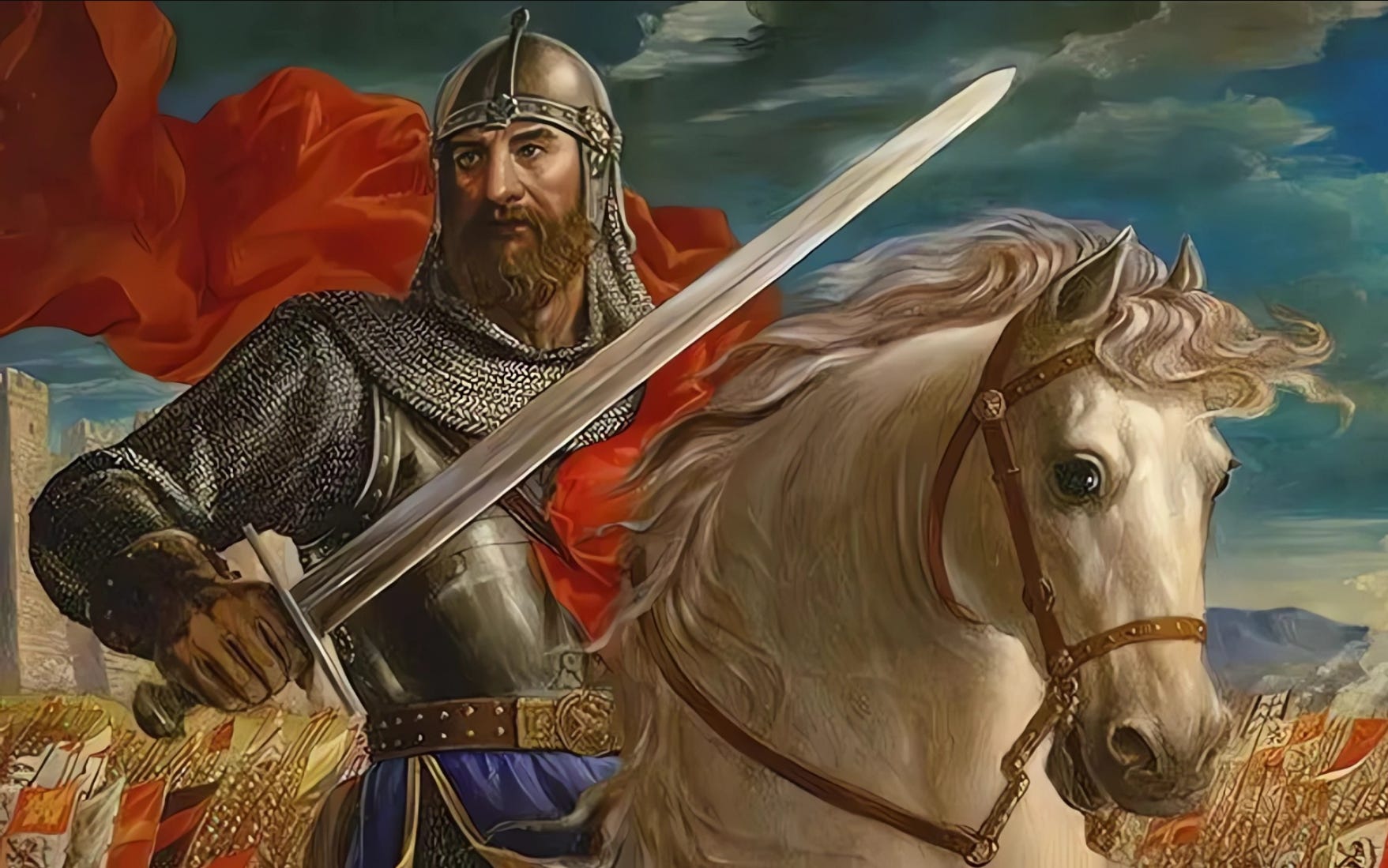
History shows us repeatedly that great leaders transcend their circumstances. El Cid had distinguished himself in Castile but could also distinguish himself with the Muslim rulers during his exile.
After five years in exile, Alfonso finally recalled El Cid out of need for reinforcements. However, during the effort to relieve a siege on Aledo, El Cid’s army failed to meet up with Alfonso’s royal army. Whether through accident or intention, he was exiled again — this time more harshly. Despite his assertions of innocence and explanations, Alfonso banished him again, taking his property and reportedly detaining his wife and children.
This was final trigger for El Cid to strike out on his own. No longer would he be in the service of another ruler. Twice exiled, he now ventured to make his own fate.
In eastern Iberia, El Cid gathered increasing power through victories, tribute, makeshift alliances, and his growing band of loyal followers. He eventually turned his ambitions toward Muslim-controlled Valencia. After a long siege of 20 months, El Cid won control of the city. After repelling a surviving threat at Cuarte, he secured his command of the region by 1094.
This cemented El Cid’s legacy. He who was exiled won back his reputation and built his own seat of power. Admittedly, he wasn’t without faults: perhaps he was brutal, or perhaps he was power-hungry or vindictive. But that was the way of things in medieval Iberia at the time. Muslim and Christian rulers were routinely vying for power against each other and among themselves. Alfonso had backed El Cid into a corner, so El Cid made his own way — and this is how he connects to today…
